I'm sure there have been numerous debates on here that involve or touch on the subject of signalling installations on prototype narrow gauge railways.
As we all know, signalling on the narrow gauge in Great Britain was only ever minimal, where it existed at all. It was rare for a line to have anything even vaguely resembling the two storey signal boxes of the standard gauge lines, most were no more than glorified ground frames. In fact most could be claimed to be exactly that, as they rarely contained the block instruments, these being more commonly located in the station buildings or offices.
A topic in another section of this site suddenly set me to wondering which the biggest narrow gauge signal box in Britain was and which had the largest signalling layout.
I have to admit to being sadly ignorant of many narrow gauge lines detailed construction. However, from the knowledge I do have I'm guessing that somewhere like Pilton Yard box on the L&B was probably one of the largest, in both respects. Unless, of course, you know different. (Which TV show was that quote from?)
Andrew
Narrow Gauge Signalling
-
Soar Valley Light

- Driver

- Posts: 1490
- Joined: Sun Dec 08, 2013 5:18 pm
- Location: North West Leicestershire
Narrow Gauge Signalling
"Smith! Why do you only come to work four days a week?
"'cause I can't manage on three gaffer!"
"'cause I can't manage on three gaffer!"
-
ikcdab
Tooban Junction on the LLSWR was a rather impressive tweo storey affair and the station was well equipped with semaphore signals.
It is (was) a very nice box - just a pity that the station was in the middle of nowhere and served nothing!
http://www.signalbox.org/overseas/ireland/toobanjcn.htm
It is (was) a very nice box - just a pity that the station was in the middle of nowhere and served nothing!
http://www.signalbox.org/overseas/ireland/toobanjcn.htm
-
Marquis DeCarabas
Re: Narrow Gauge Signalling
I'm afraid that's far from the truth, consider the Irish lines. I note that Tooban has already been mentioned, then there are also the boxes on the CDRJC, the double track lines on the Cork, Blackrock and Passage. There are then the numerous signalboxes on the Festiniog, North Wales Narrow Gauge, Corris and the solitary example on the Campbeltown.Soar Valley Light:109942 wrote:As we all know, signalling on the narrow gauge in Great Britain was only ever minimal, where it existed at all. It was rare for a line to have anything even vaguely resembling the two storey signal boxes of the standard gauge lines, most were no more than glorified ground frames. In fact most could be claimed to be exactly that, as they rarely contained the block instruments, these being more commonly located in the station buildings or offices.
Douglas would get my first vote, followed by Tryfan Junction then the second signalbox at Blaenau Festiniog No 3. - in terms of number of levers, though one of the two at Stranorlar would probably be larger.Soar Valley Light:109942 wrote:A topic in another section of this site suddenly set me to wondering which the biggest narrow gauge signal box in Britain was and which had the largest signalling layout.
Sadly not, Pilton would have been fairly low down the rankings in terms of size and area controlled. I think the largest area controlled in terms of length of track would have been the second box at Blaenau Festinog No 2, which was a joint box with the GWR.Soar Valley Light:109942 wrote:I have to admit to being sadly ignorant of many narrow gauge lines detailed construction. However, from the knowledge I do have I'm guessing that somewhere like Pilton Yard box on the L&B was probably one of the largest, in both respects. Unless, of course, you know different. (Which TV show was that quote from?)
Block instruments, now that's an interesting one - most of the lines that used instruments - either single needle telegraph or conventional AB instruments or METS instruments had then in the signalboxes. Those that worked by Train Staff and Ticket would have generally had the telephone in the station building.
In comparison the later NG lines built after the Light Railways Act had the simplified signalling, those before were a bit more grand than 'glorified groundframes' - dig around a bit further and prepare to revise your opinions.

-
Soar Valley Light
- Driver
- Posts: 1490
- Joined: Sun Dec 08, 2013 5:18 pm
- Location: North West Leicestershire
I began to wonder if my bait was going to be taken with this topic. The two people I thought most likely to respond have!
I must learn to be a little bit more specific, I was really referring to mainland Britain. I'm probably even more ignorant about the detail of Irish narrow gauge, despite the discovery of it in a library book about narrow gauge railways of Britain, (many more years ago than I care to remember) being the main spur of my NG interest!
I had never drawn the distinction between the Light Railway act and the simplification of signalling on the narrow gauge. A ridiculous state to be in as I'm well aware of it's affect on standard gauge lines.
I certainly hadn't appreciated that the block instruments were generally in the boxes and was even less aware of there being anything other than single line instruments (apart from TS&T by phone of course). Am I correct in deducing from the Marquis' posting that standard pegging and repeating block instruments were in use somewhere?
I used to think I knew a little bit about NG signalling but the more I write (and read) the more I realise how little I actually do know! I wish I had more time to research the subject. Thanks for your responses chaps, they are very interesting and informative, please keep 'em coming!
Does a list exist of narrow gauge signal boxes on the NG lines of mainland Britain?
I must learn to be a little bit more specific, I was really referring to mainland Britain. I'm probably even more ignorant about the detail of Irish narrow gauge, despite the discovery of it in a library book about narrow gauge railways of Britain, (many more years ago than I care to remember) being the main spur of my NG interest!
I had never drawn the distinction between the Light Railway act and the simplification of signalling on the narrow gauge. A ridiculous state to be in as I'm well aware of it's affect on standard gauge lines.
I certainly hadn't appreciated that the block instruments were generally in the boxes and was even less aware of there being anything other than single line instruments (apart from TS&T by phone of course). Am I correct in deducing from the Marquis' posting that standard pegging and repeating block instruments were in use somewhere?
I used to think I knew a little bit about NG signalling but the more I write (and read) the more I realise how little I actually do know! I wish I had more time to research the subject. Thanks for your responses chaps, they are very interesting and informative, please keep 'em coming!
Does a list exist of narrow gauge signal boxes on the NG lines of mainland Britain?
"Smith! Why do you only come to work four days a week?
"'cause I can't manage on three gaffer!"
"'cause I can't manage on three gaffer!"
-
Marquis DeCarabas
Signalboxes as in your average 'box: off the top of my head, I have not attempted to make any distinction between block and non-block signalboxes
NWNG
Dinas, Tryfan Junction, Waenfawr, Bryngwyn
Corris
Machynlleth East and West, Maespoeth, Corris
Festiniog
2x No 3 (Old and New Dinas Junction) 2x No 2 (Duffws Junction) 1x No 1 (Duffws)
Welshpool and Llanfair
Castle Caereinion
Campbeltown and Macrihanish
Lintmill
MailRail
Assorted control rooms - ?4 with magazine-type TCB describers
L&B
Barnstaple Town, Pilton (Bridge), Lynton
Garden Shed signalboxes and open groundframes controlling interlocked signals not included.
How's that for starters?
NWNG
Dinas, Tryfan Junction, Waenfawr, Bryngwyn
Corris
Machynlleth East and West, Maespoeth, Corris
Festiniog
2x No 3 (Old and New Dinas Junction) 2x No 2 (Duffws Junction) 1x No 1 (Duffws)
Welshpool and Llanfair
Castle Caereinion
Campbeltown and Macrihanish
Lintmill
MailRail
Assorted control rooms - ?4 with magazine-type TCB describers
L&B
Barnstaple Town, Pilton (Bridge), Lynton
Garden Shed signalboxes and open groundframes controlling interlocked signals not included.
How's that for starters?
-
Andrew

- Moderator

- Posts: 3422
- Joined: Tue Jul 03, 2012 1:33 pm
- Location: Bristol, UK
- Contact:
If you're still around Marquis, did the NWNGR boxes continue to house point levers in WHR days, ground-frame style? I think the block instruments went into the station building offices when the conventional signalling was decommissioned?
I'm currently in the early stages of constructing an NWNGR station building for my line and would like to build a signalbox to go with it, but I wonder what, if anything, they were used for by the mid-20s. Would have made nice greenhouses had there been station staff to tend them, but I think they went not long after the signals at all the intermediate stations except Beddgelert?
I did once have a look at the Mail Rail control box during an open day in the 80s, amazing... Ooh, that's made me think - during the Channel Tunnel construction the 2' system was pretty extensive I think, wonder how that was controlled?
Cheers,
Andrew.
I'm currently in the early stages of constructing an NWNGR station building for my line and would like to build a signalbox to go with it, but I wonder what, if anything, they were used for by the mid-20s. Would have made nice greenhouses had there been station staff to tend them, but I think they went not long after the signals at all the intermediate stations except Beddgelert?
I did once have a look at the Mail Rail control box during an open day in the 80s, amazing... Ooh, that's made me think - during the Channel Tunnel construction the 2' system was pretty extensive I think, wonder how that was controlled?
Cheers,
Andrew.
-
Marquis DeCarabas
-
Soar Valley Light
- Driver
- Posts: 1490
- Joined: Sun Dec 08, 2013 5:18 pm
- Location: North West Leicestershire
Many thanks for your reply MdC. Interesting information indeed.
The number of 'ground frame' type installations must be more numerous but even so signalled locations were clearly in the minority and on a diminishing scale at that!
It's sad that lines like the NWNG abandoned signalling but completely understandable. The number of staff required to man these railways as built is quite striking and a clear indication of the economics of the time.
I hadn't appreciated that weighted points had replaced the signalling on the WHR, I wasn't even aware that this would be acceptable to the 'galloping majors' of the HMRI. I understood that even on light railways there was a requirement for points to be locked. It would appear that I have that wrong.
Whilst I love signalling I don't intend to have any on my garden line. This is in no small part due to it's inability to resist 'bombing raids' from the next door kids football; indeed, all scenery will be minimal for the same reason. I was planning to have ground frames for the points in the running line but maybe I now have a way round even that. It would certainly avoid the need to design and build 'bomb proof' ground frame huts!!!
The depth of information available and freely shared on this forum never ceases to amaze me. Thanks guys.
Andrew
The number of 'ground frame' type installations must be more numerous but even so signalled locations were clearly in the minority and on a diminishing scale at that!
It's sad that lines like the NWNG abandoned signalling but completely understandable. The number of staff required to man these railways as built is quite striking and a clear indication of the economics of the time.
I hadn't appreciated that weighted points had replaced the signalling on the WHR, I wasn't even aware that this would be acceptable to the 'galloping majors' of the HMRI. I understood that even on light railways there was a requirement for points to be locked. It would appear that I have that wrong.
Whilst I love signalling I don't intend to have any on my garden line. This is in no small part due to it's inability to resist 'bombing raids' from the next door kids football; indeed, all scenery will be minimal for the same reason. I was planning to have ground frames for the points in the running line but maybe I now have a way round even that. It would certainly avoid the need to design and build 'bomb proof' ground frame huts!!!
The depth of information available and freely shared on this forum never ceases to amaze me. Thanks guys.
Andrew
"Smith! Why do you only come to work four days a week?
"'cause I can't manage on three gaffer!"
"'cause I can't manage on three gaffer!"
-
MuzTrem
Of course, the other area where one could be pedantic is: what do you mean by narrow gauge? The Romney, Hythe and Dymchurch has 'boxes at Hythe and New Romney...Soar Valley Light:110034 wrote:I must learn to be a little bit more specific, I was really referring to mainland Britain.

(I couldn't tell you anything about them though - I'm afraid signalling isn't really my specialism!)
-
Marquis DeCarabas
Just a quick reply as I'm on my phone on the way back from evening ringing. This isn't exhaustive but:Soar Valley Light:110058 wrote:Many thanks for your reply MdC. Interesting information indeed.
The number of 'ground frame' type installations must be more numerous but even so signalled locations were clearly in the minority and on a diminishing scale at that!
Ground frames with semaphores: Waterhouses, Hulme End, Tennis Ground, Manor Copse, Fridd Gate, Garneddwen, Aberllefenni, Portmadoc, Croesor Crossing, Park Avenue, Capel Bangor, Aberffrwdd, Devils Bridge, South Snowdon, Bettws Garmon, Llanberis, Halfway, Clogwyn, Summit, Glanypwll Crossing (MS&L frame).
Semaphores without groundframes:
Block Semaphores: Portmadoc, Minffordd (ex Rhiw Goch, probably), Penrhyn, Tanybwlch (ex Hafodyllyn), Tanygrisiau, 2 at ODJ, Dinas, Duffws (although some evidence would suggest otherwise, and the block semaphore at Duffws was second hand from Dinas post-doubling), Halesworth, Wenhaston, Blythburgh and one of the pair at Southwold.
Just plain semaphores Llwyngwern, Pont Evans, plus the gate-worked discs at Waterhouses LC.
There may be more. Can't remember, sorry.
-
IrishPeter
How does Douglas do on the list? 36 levers controlling a four platform terminus, carriage sidings, a four road goods yard, and approaches. Dutton 'drink handle' type frame, and mainly original until disconnected in stages 1970-79
The other IMR signal box, St John's, was a bit of a tiddler by comparison - 10 levers. Stevens & Co, frame of the Scottish type dating from 1879. Signals were a mix of Stevens and Lindley equipment. Closed 1968; demolished 1976.
Stevens 9 lever ground frames at St John's MNR Station (1884) largely disconnected by 1940; removed 1976. Similar GF at Foxdale, which probably disappeared around 1941, though the signals were probably disconnected about 1912.
Peter in AZ
The other IMR signal box, St John's, was a bit of a tiddler by comparison - 10 levers. Stevens & Co, frame of the Scottish type dating from 1879. Signals were a mix of Stevens and Lindley equipment. Closed 1968; demolished 1976.
Stevens 9 lever ground frames at St John's MNR Station (1884) largely disconnected by 1940; removed 1976. Similar GF at Foxdale, which probably disappeared around 1941, though the signals were probably disconnected about 1912.
Peter in AZ
-
Andrew
- Moderator
- Posts: 3422
- Joined: Tue Jul 03, 2012 1:33 pm
- Location: Bristol, UK
- Contact:
About 20 years ago - post-privatisation but pre-beautification - there used to be a single signal on the VoR which stood on the (2') main line by Aberystwyth shed. Presumably it was there to enable shunting manoeuvres while there was a train up the line, but I used to find it vaguely amusing, it looked a bit like it a random accessory plonked by the side of a train set...
Andrew
PS Nice to have you both back Irish Peter and M de C - you used just the right bait SVR Andrew! I hope this finds you both well...
Andrew
PS Nice to have you both back Irish Peter and M de C - you used just the right bait SVR Andrew! I hope this finds you both well...
-
IrishPeter
Especially if you plonk them at either end of a passing loop. British Light Railways often had very little fixed signalling as the requirements were pretty minimal:
Home signals were required at the entrance to passing loops, and some form of signalling at gated level crossing which could not be clearly seen at 440yds.
Distant signals were only required if the home signals were not visible at 440yds.
Starting signals were not required at all, but paradoxically, were often installed!
Of course the Welsh Highland even managed to 'one-up' them on this by having no signals at all, and regulations governing the train crew operating the staff and ticket system at unstaffed loops. Basically, the guard played stationmaster as necessary. With the low speeds involved and the 5 mph speed limits wherever there was a possibility of a head-on collision, the danger of their being a serious accident was very slight indeed.
OTOH, before 1896, 'full' signalling was required and this definitely had an influence on the L&B, Corris (converted for passenger operation mid-1880s,) and the Festiniog (constantly upgrading). The others tended to be too early for the conventional Signal Box to occur. The Southwold - built 1878/9 - makes an Isle of Man Railway type feel right at home - weighted points interlocked with the signals via slot detectors, with signals worked off hand levers. On the other hand the Corris' signalling was pretty much up to mainline standards with small SBs controlling the major locations even though it is only half-a-dozen years after the Southwold.
I missed the rubric about it being 'Big Island' only - especially as Ireland was mentioned early on.
Peter in AZ
Home signals were required at the entrance to passing loops, and some form of signalling at gated level crossing which could not be clearly seen at 440yds.
Distant signals were only required if the home signals were not visible at 440yds.
Starting signals were not required at all, but paradoxically, were often installed!
Of course the Welsh Highland even managed to 'one-up' them on this by having no signals at all, and regulations governing the train crew operating the staff and ticket system at unstaffed loops. Basically, the guard played stationmaster as necessary. With the low speeds involved and the 5 mph speed limits wherever there was a possibility of a head-on collision, the danger of their being a serious accident was very slight indeed.
OTOH, before 1896, 'full' signalling was required and this definitely had an influence on the L&B, Corris (converted for passenger operation mid-1880s,) and the Festiniog (constantly upgrading). The others tended to be too early for the conventional Signal Box to occur. The Southwold - built 1878/9 - makes an Isle of Man Railway type feel right at home - weighted points interlocked with the signals via slot detectors, with signals worked off hand levers. On the other hand the Corris' signalling was pretty much up to mainline standards with small SBs controlling the major locations even though it is only half-a-dozen years after the Southwold.
I missed the rubric about it being 'Big Island' only - especially as Ireland was mentioned early on.
Peter in AZ
-
Marquis DeCarabas
Yuss. Am busy untangling the story of the Duffws Branch signalling at the moment. I've manage to get to the bottom of what happened when the F&B arrived on the scene. Lots more to do, including sorting out which bits of which lines stayed passenger and which bits swapped to the goods. Awful lot of emBoydery.Andrew:110309 wrote:PS Nice to have you both back Irish Peter and M de C - you used just the right bait SVR Andrew! I hope this finds you both well...
It is a bit, if you're used to the 440yd overlap rule - this is something that didn't translate too well to the narrow gauge, and I think is often forgotten by modellers who remember that it is needed on double track lines, but not on single lines: the overlap would be the length of line form the home to the starter and depending on the contractor the home could be a long way away from the loop points or right on top of them.Andrew:110309 wrote:About 20 years ago - post-privatisation but pre-beautification - there used to be a single signal on the VoR which stood on the (2') main line by Aberystwyth shed. Presumably it was there to enable shunting manoeuvres while there was a train up the line, but I used to find it vaguely amusing, it looked a bit like it a random accessory plonked by the side of a train set...
In the specific case of Aberystwyth (1968) it was a very simple LNW tappet ground frame originally with four levers that had the home signal as lever 1, post-privatisation it was reworked from a minimalist LMR installation to a slightly more complicated design based on South Tynedale Railway practice: understandable given the GM of the time.
Let me rustle around my notes and see what I can dig up. There may be pictures.
-
ge_rik
- Administrator
- Posts: 7975
- Joined: Sun Oct 25, 2009 10:20 pm
- Location: Cheshire
- Contact:
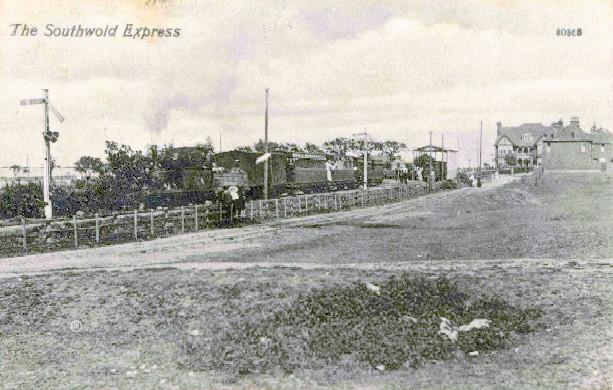
What a fascinating thread. I was aware of some of the details, but hadn't realised the Southwold signals were interlocked with the points. I must admit, I've always quite liked the double armed SR signals and have assumed they act as both starters and homes.
This postcard has always intrigued me as the inner and outer signals seem quite close. Would the outer/advance starter indicate the limit of shunting, do you think?
Rik
This postcard has always intrigued me as the inner and outer signals seem quite close. Would the outer/advance starter indicate the limit of shunting, do you think?
Rik
-
Marquis DeCarabas
Oh! You tempt me too much - I have a huge bundle of notes and signalling regulations from the Southwold. Let me finish off the Aberystwyth diagram (nearly done, just hand-kerning bits) and I'll have a look for the Southwold stuff.
The postcard is interesting, because it does not have the lower distant arm and I can't tell if the bothy is by the inner signal. I shall have to dig out my copy of Honky-Tonk's book.
The postcard is interesting, because it does not have the lower distant arm and I can't tell if the bothy is by the inner signal. I shall have to dig out my copy of Honky-Tonk's book.
-
Marquis DeCarabas

-
Marquis DeCarabas
Right, I've found my copy of some of the Southwold stuff - there may be more lurking in the corners of this machine. Here's a pic of Southwold station throat that may help - you can see the y-shaped yokes from the point blades to the signal hand levers.

These are combined 'block' semaphores and point indicators, I think. This appelation does not universally apply, but I would a) need to look at the 1908 signalling regulations carefully and b) check to see if there were more than one centrally or only at one end of the loops.
The Trundle is taking me out for a bite to eat, when I return from the wilds of Herne Bay I shall look a bit further.
These are combined 'block' semaphores and point indicators, I think. This appelation does not universally apply, but I would a) need to look at the 1908 signalling regulations carefully and b) check to see if there were more than one centrally or only at one end of the loops.
The Trundle is taking me out for a bite to eat, when I return from the wilds of Herne Bay I shall look a bit further.
Who is online
Users browsing this forum: No registered users and 9 guests