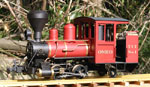

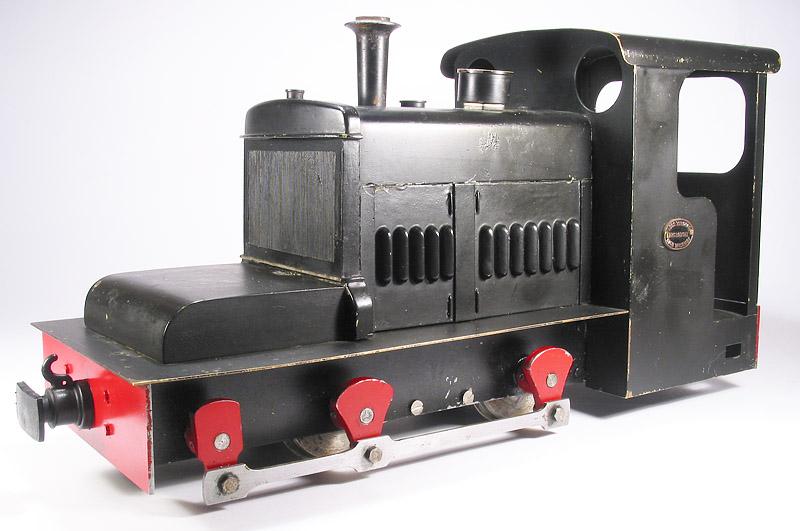
This turned out to be a Merlin Motor Mule built in the '80s, originally sold by Tom Cooper under his Steamlines name, which had somehow made it's way to Australia.
Accurately named as it happens, since it is ugly, strong and of no discernable pedigree, just like a pack mule.......

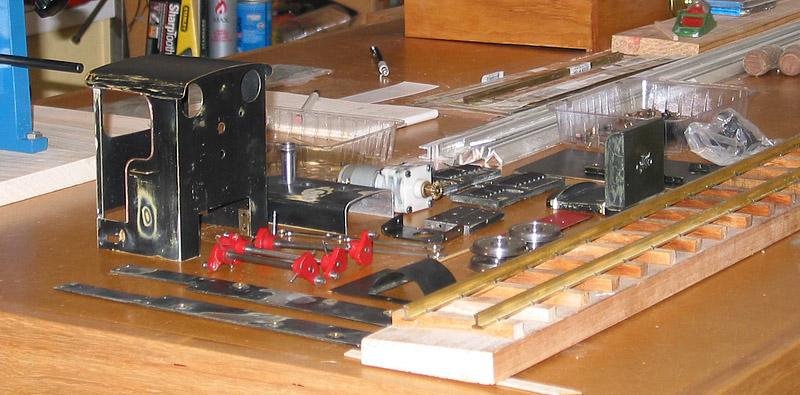
Once the Argyle Philadelphia was back in service, it was time to give it's stablemate some attention after gathering dust in the workshop for many months. Close inspection suggested a rail up rebuild was in order, so it was stripped down to it's components and various bits replaced, repaired, or refurbished.
Spread out on the work bench is a set of the usable parts and a dish of those bits that were replaced, mostly screws and nuts.
Some digging around in my library turned up an article in 'Light Railways' on the Fowler petrol mechanicals that once worked in Australia on the 2' gauge sugarcane tramways in Queensland. A couple of these are still running in preservation, although long since re-engined with diesel prime movers. The article helpfully included a Fowler GA and some extracts from the Fowler catalogue of the time.
It didn't take long to work out that the 'mule' was what the aero modellers call standoff scale (ie. it looks like a scale model if you stand far enough away), as none of the dimensions matched any known Fowler PM loco. Although it was obviously based on one of the small 0-4-0 versions, it measures out about the size of one of the larger and more powerful 0-6-0 versions.
A previous owner had stripped out the original battery and control system, replacing it with pickups so it could be run with track power. The motor and gears were in good condition, but the pickups had to go, as I'm not in favour of track power in the garden.
The work done on the chassis included adding some detail to the coupling rods, sleeving the wheels so they would fit the axles properly, trueing up the wheels, adding Accucraft chopper couplers and enclosing the bevel gears to keep out dirt.
The body was mostly cosmetic work, requiring a fair amount of work on the hood castings and cab platework. While some extra detailing was added, it wasn't worth trying to fix the errors in the model. If you want an accurate model of a Fowler PM, buy the Essel model.


The battery containing 8 x 2000 mAh NiMH AA cells and a simple transistor based speed controller were fitted under the hood and the controls were fitted in the cab. The Como motor/gearbox unit draws <1 amp under load, so the batteries give 2 -3 hours running, depending on load and track conditions. That's longer than my attention span anyway, but more cells could be fitted under the chassis to give a longer run if necessary.
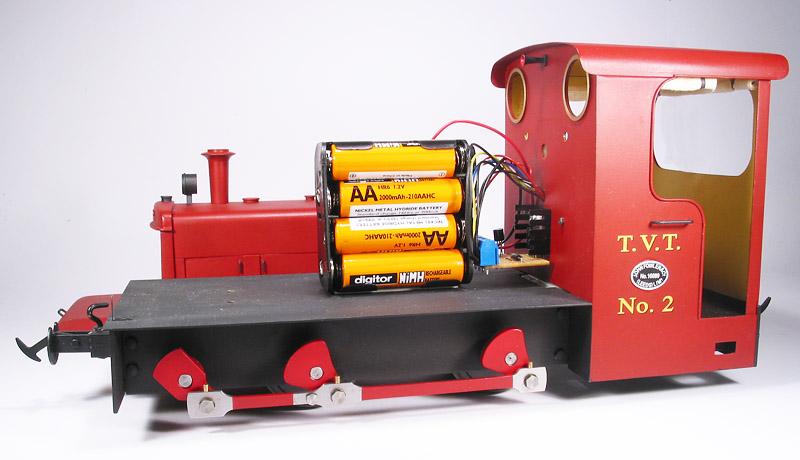
The speed control is disguised as the handbrake standard, while in order from left to right, the charging socket (just out of sight), the on/charge/off switch and the for/rev switch are fitted into a simple folded brass box to vaguely resemble the cab control layout of a real Fowler.

The loco had it's first run back in October and while the planetary gearbox and bevel gear final drive make it sound like a coffee grinder, it is very controllable down to quite low speeds and will creep along at about 1 sleeper every 3 seconds. The wheel treads are a bit narrow for 45mm gauge, but it will successfully negotiate Sunset Valley turnouts. The weight of the batteries has moved the balance point forward far enough that it is no longer tail heavy, making it much more stable on the track.
I only got around to making and fitting the builders plates a couple of days before Christmas and since it has been nice and sunny the last few days, it has now posed for it's official portrait in the backyard jungle.


TVT History.
By the late '20s the little Baldwins bought to build the TVT were reaching their use by date and parts of No. 2 were used to rebuild No. 1, the remains of No. 2 then being left to slowly rust in the grass behind the workshops, until a scrap drive in WWII sealed it's fate.
Around the same time the General Manager had a rush of blood to the brain which co-incided with a visit from the Fowler salesman and after some delay a large wooden crate arrived in the transfer yard on a VR well wagon with a Waukesha engined Fowler PM inside.
Unfortunately he hadn't talked to his CSR counterparts in Queensland (although the Engineer had), so he hadn't found out that it wasn't fast enough to run mainline trains, nor would it develop full power when run on power kerosene, and high octane petrol was expensive. CSR had also found the US built Waukesha engine had a distressing habit of breaking crankshafts.
Against the engineer's written advice, it was tried on a mainline mixed train and the trip rapidly descended into farce. Although the TVT had a maximum permitted speed of only 20 mph, the mixed had to maintain an average of 15 mph to meet the timetable. The Fowler could just manage 9 mph in top gear on the flat and on the ruling 1:40 grades of the TVT it was in first gear and down to 3 mph.
Unfortunately, the chairman of the railway committee was on the train, while the engineer had wisely applied for leave and gone bush.
When someone later asked if it should be named like other TVT locos, the engineer helpfully suggested the name CANARDLY would be suitable. The new GM was smart enough to have it given the number of the recently withdrawn No. 2 and banished it to the old Baldwin's task of shunting the wharf branch.
Which is why it remains 'The Mule with no Name' ........ 8)
Regards,
Graeme


