

That's pretty much what I understand takes place. From what I see of the LNR the exit from the sidings is controlled by ground signals which suggests control of the trains from those locations would be under the auspices of the signalman.
Ian
The Leawarra Nayook Railway
-
Soar Valley Light
- Driver

- Posts: 1489
- Joined: Sun Dec 08, 2013 5:18 pm
- Location: North West Leicestershire
Even in the (over?)regulated UK, minor railways were often lightly signalled or not signalled at all. Signals controlling the entrance to the section were rarely locked by the train staff, that was a luxury that even many mainline companies reserved for more important lines. I learnt signalling in the mid seventies in a box that had free section signals!
Connections into running lines may well have been unlocked by the train staff (or by a padlock unlocked by a key attached to the staff), but once inside of that then most railways would have hand worked points (usually from a lever at the point toe), operated by the train crew. Very few (if any) narrow gauge railways would have employed shunters, there was no need, the Guard could cope with the work. Some quarry lines may have been different of course, they probably didn't have Guards!
I remember a discussion with the late Major Olver of the HMRI many years ago about a proposed signalling layout for a heritage line. He didn't particularly like signals on heritage lines, not seeing any particular need for them in many cases. He was very cautious of unnecessary over complication. His guiding principle about any scheme was that every signal should have a purpsoe and that no signal should be provided unless there was a bl**dy good reason to have it. He would ask searching questions about each one. A good reason was not that a move may be made once every blue moon! Most companies in the 'good old days' would apply the same priciple but on the grounds of cost!
I love signalling, it's my greatest passion, but my own line is unlikely to see any signals at all on the basis that the fictional line it will represent would have been unlikely to have had anything more than train staff released points........ but as I've said in may previoous posts - each to his own!
Andrew
Connections into running lines may well have been unlocked by the train staff (or by a padlock unlocked by a key attached to the staff), but once inside of that then most railways would have hand worked points (usually from a lever at the point toe), operated by the train crew. Very few (if any) narrow gauge railways would have employed shunters, there was no need, the Guard could cope with the work. Some quarry lines may have been different of course, they probably didn't have Guards!
I remember a discussion with the late Major Olver of the HMRI many years ago about a proposed signalling layout for a heritage line. He didn't particularly like signals on heritage lines, not seeing any particular need for them in many cases. He was very cautious of unnecessary over complication. His guiding principle about any scheme was that every signal should have a purpsoe and that no signal should be provided unless there was a bl**dy good reason to have it. He would ask searching questions about each one. A good reason was not that a move may be made once every blue moon! Most companies in the 'good old days' would apply the same priciple but on the grounds of cost!
I love signalling, it's my greatest passion, but my own line is unlikely to see any signals at all on the basis that the fictional line it will represent would have been unlikely to have had anything more than train staff released points........ but as I've said in may previoous posts - each to his own!
Andrew
"Smith! Why do you only come to work four days a week?
"'cause I can't manage on three gaffer!"
"'cause I can't manage on three gaffer!"
-
LNR

- Driver
- Posts: 1833
- Joined: Sat Feb 27, 2016 5:26 am
- Location: Melbourne, Australia
I am the first to admit that I have over signaled Leawarra. As Graham said a home signal would be the only one necessary, but that would be facing away and not visible anyway.
I liked the idea of a few levers to work, and in true VR style they would normally be open levers tucked away beside a building and worked from the track side of the platform.
Like Topsy the idea sort of grew. But I'm glad to have "flown the kite" because I've learnt much more thanks to the forum and its members.
Grant.
I liked the idea of a few levers to work, and in true VR style they would normally be open levers tucked away beside a building and worked from the track side of the platform.
Like Topsy the idea sort of grew. But I'm glad to have "flown the kite" because I've learnt much more thanks to the forum and its members.
Grant.
-
Soar Valley Light
- Driver
- Posts: 1489
- Joined: Sun Dec 08, 2013 5:18 pm
- Location: North West Leicestershire
And a cracking job you made of it too Grant. Small ground frames weren't that uncommon on British narrow gauge lines, often just working the points in the running line though. All black levers and no red ones! As such you're small frame seems quite in keeping to me. I'm SO impressed with your ground signals too!
Andrew
Andrew
"Smith! Why do you only come to work four days a week?
"'cause I can't manage on three gaffer!"
"'cause I can't manage on three gaffer!"
-
IrishPeter
Actually, the 1889 Act does not say much more than 'points and signals on running lines must be interlocked.' So on light railways, and minor lines, it would be it could be enough to simply have a detector on the point wire to ensure the signal could not be pulled off when the points were aligned wrong road. However, arrangements in the UK were usually more sophisticated than that simply because the track layouts were more complex, and running speeds higher.
Peter in AZ
Peter in AZ
-
LNR
- Driver
- Posts: 1833
- Joined: Sat Feb 27, 2016 5:26 am
- Location: Melbourne, Australia
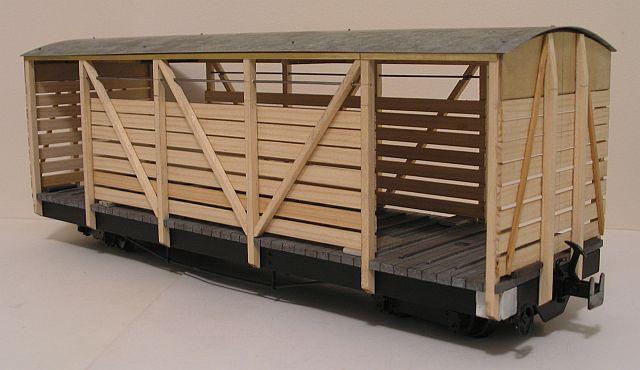
On returning to the workshop with signalling in mind, I saw the second underframe of the two recently built. So began the process of deciding how to construct a cattle truck that was both structually strong, and yet displayed the open airy appearance of those on the VR narrow gauge.
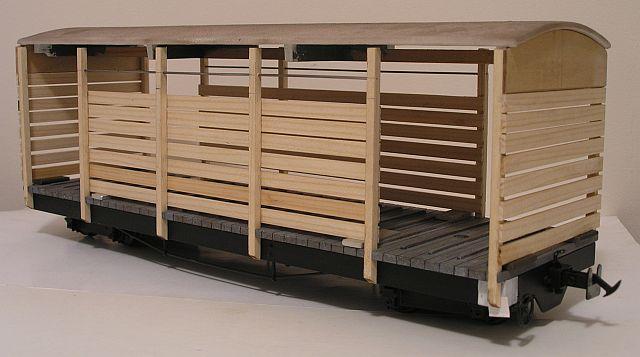
Basic box constructed so far. Roof borrowed from U van to get an idea of the size. Will have a flat iron roof when done. More timber bracing and of course doors, then the detailing can start.
Grant.
Basic box constructed so far. Roof borrowed from U van to get an idea of the size. Will have a flat iron roof when done. More timber bracing and of course doors, then the detailing can start.
Grant.
-
Soar Valley Light
- Driver
- Posts: 1489
- Joined: Sun Dec 08, 2013 5:18 pm
- Location: North West Leicestershire
That's an interesting vehicle Grant. Bigger than some of our standard gauge cattle wagons by the looks of it! I look forward to seeing it progress. Were the full sized ones fitted with continuous brakes?
I'm intrigued by the thought process that took you from signalling to cattle!
Andrew
I'm intrigued by the thought process that took you from signalling to cattle!
Andrew
"Smith! Why do you only come to work four days a week?
"'cause I can't manage on three gaffer!"
"'cause I can't manage on three gaffer!"
-
LNR
- Driver
- Posts: 1833
- Joined: Sat Feb 27, 2016 5:26 am
- Location: Melbourne, Australia
Andrew, the only thought process was "oh forgot I still had one to go, better do something about it"!!!
The real NM's were a little over a foot higher than other van stock on the narrow gauge, but I didn't want to go that high. It still sits on my standard underframe, but is built a little more outside it, as the timber uprights extend down outside the frame. The real ones used steel angle, but cost and availability of K&S brass angle was a bit prohibitive.
Oh and yes, all our VR narrow gauge stock was air braked.
Grant.
The real NM's were a little over a foot higher than other van stock on the narrow gauge, but I didn't want to go that high. It still sits on my standard underframe, but is built a little more outside it, as the timber uprights extend down outside the frame. The real ones used steel angle, but cost and availability of K&S brass angle was a bit prohibitive.
Oh and yes, all our VR narrow gauge stock was air braked.
Grant.
-
Tropic Blunder
- Trainee Fireman

- Posts: 227
- Joined: Sun Dec 06, 2015 4:02 am
- Location: Australia
- Contact:

-
Soar Valley Light
- Driver
- Posts: 1489
- Joined: Sun Dec 08, 2013 5:18 pm
- Location: North West Leicestershire
-
GTB
- Driver
- Posts: 1690
- Joined: Sat Mar 05, 2011 2:46 pm
- Location: Australia
The VR narrow gauge cattle trucks were the same inside height as the broad gauge ones. Cattle don't need 7" of headroom, but horses do and most of them travelled in 'cattle' trucks here. Only bloodstock travelled first class in a horse box.Soar Valley Light:119844 wrote: Interesting that they were taller. Was that to make room for the occupants?
Graeme
-
LNR
- Driver
- Posts: 1833
- Joined: Sat Feb 27, 2016 5:26 am
- Location: Melbourne, Australia
Sick of making hinges and doors, and whilst doing the weekly shop, I saw these strange coloured animals going really cheap in the Reject shop. Thought I might have some fun, as well as good practice.
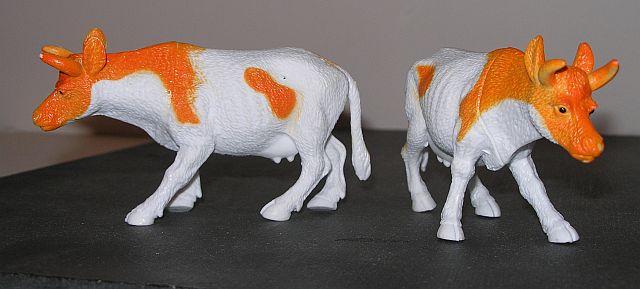
After sticking pins and wires in them (there sort of rubbery plastic something) to get them standing properly, re-positioning ears and then cutting the head off one to insert a wooden former for a different pose I got some paint on them. Decided the only breed they remotely resemble is a Hereford
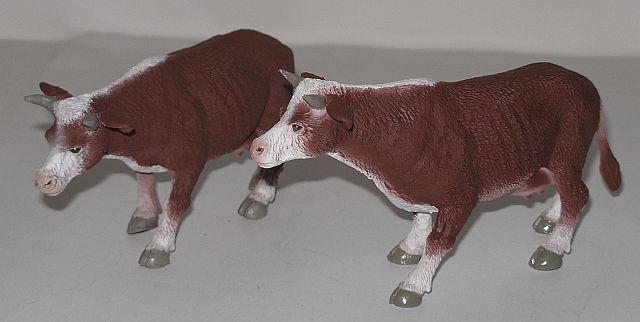
Not finished yet, but it was fun and quite a refreshing change.
Grant.
After sticking pins and wires in them (there sort of rubbery plastic something) to get them standing properly, re-positioning ears and then cutting the head off one to insert a wooden former for a different pose I got some paint on them. Decided the only breed they remotely resemble is a Hereford
Not finished yet, but it was fun and quite a refreshing change.
Grant.
-
Peter Butler

- Driver
- Posts: 5671
- Joined: Sun Sep 09, 2012 10:33 pm
- Location: West Wales

-
Soar Valley Light
- Driver
- Posts: 1489
- Joined: Sun Dec 08, 2013 5:18 pm
- Location: North West Leicestershire

-
LNR
- Driver
- Posts: 1833
- Joined: Sat Feb 27, 2016 5:26 am
- Location: Melbourne, Australia
Yes, I'm not sure what animal was in the makers eye but don't think it was a cow. Still keeping my eye out for some more Schleich/Collecta cows. Very hard to get a herd of same breed cattle in different poses. I already have the Schleich Holstein as most do, a large framed beast in real life, and hard to match up to. These two if used will have to be in the middle of a group I suspect, small mixed herds being common here in Australia in the era I'm modelling.
Grant.
Grant.
-
GTB
- Driver
- Posts: 1690
- Joined: Sat Mar 05, 2011 2:46 pm
- Location: Australia
What height are they at the shoulder Grant?LNR:119987 wrote: Decided the only breed they remotely resemble is a Hereford.
I'd like to load some of my cattle trucks, but I'd go broke using Schleich Herefords. The only cheap toy cows I've seen locally were some in Big W which looked like Friesians, but stood almost 6' in 1:20 scale.
I agree I've never seen a cow that looks like the ones you have, but once packed into a cattle truck, they'll look OK if the size is about right.
Regards,
Graeme
-
tom_tom_go
- Driver
- Posts: 4824
- Joined: Wed Feb 23, 2011 3:08 am
- Location: Kent, UK
- Contact:
Who is online
Users browsing this forum: drewzero1 and 17 guests