Whosk:96593 wrote:I could go the press the rivet way but I'll have to make/purchase a rivet punch, probably the former as the later will be too expensive here in Australia
Decals look OK in HO, but I've not seen any that are made for SM32/45. Sticking on individual rivets is a sure fire ticket to a stay in the rubber room...... Rivet presses are dead boring to use as well, but are quicker.
I've had a NWSL Rivetter+ for many years. Lloyd's used to stock them here in Oz and I bought mine from him at an AMRA exhibition. I think NWSL no longer produce them and the MicroMark copy is also no longer listed.
I found it was a bit small for some Fn3 scale model parts when I changed scale, so I recently made a larger version that works the same way, but fits in my mill/drill.
This pic. is the rear panel of a tender I made recently with the new riveter table. The rivets are 0.7mm dia. at 1.5mm pitch around the edge and the same size at 5mm pitch on the staggered rows in the centre of the plate. This piece is made from 0.5mm brass plate, which I find is thick enough in this scale.

This is the riveter table set up in the mill.

For a cheaper alternative to a commercial press, the sketch below shows a DIY type of rivet press designed to be used with a bench drill,which is based on one used by a friend of mine. Drawn in Back of the Envelope CAD, so you are on your own with my handwriting. No dimensions, as they depend on your bench drill. Cost would be a function of what sort of scrap bin you keep in the shed.....
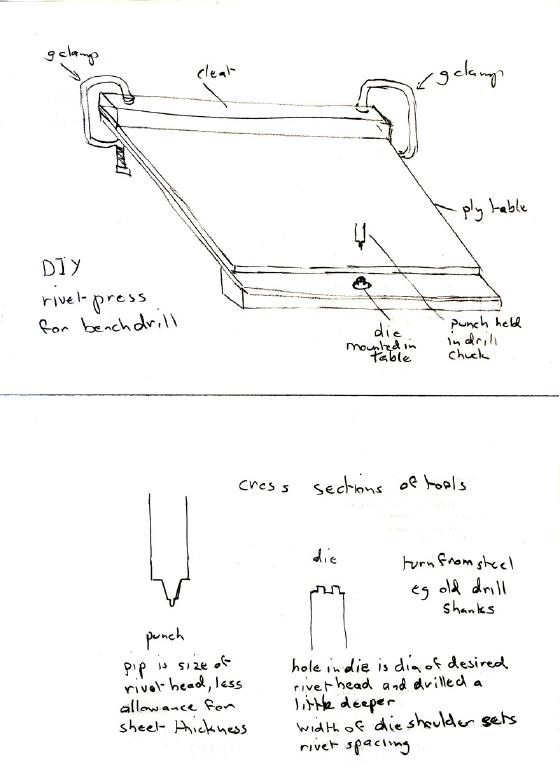
If you don't have facilities to make the punch and die, you can still buy the NWSL ones from the US. They are cheap enough at US$20 a pair and they come in a range of rivet sizes. If you make your own, it is the punch that sets the shape of the rivet head, the hole in the die just needs to be deep enough, it doesn't need a round bottom to the hole.
To use it, the fence is clamped in place and the part is slid along it to make the row of rivets. Rivet spacing is set by the die and all you do is punch one rivet, slide the part along, push the last rivet against the die and punch the next one. There is a step along the front of the table to clear the rivets once punched and the top of the die should be flush with the table surface. The die needs to be firmly fixed in place so it can't wobble around. Don't press too hard, or the punch will thin the metal out around the rivet impression and distort the edge of the part.
There are people that will say you can use an automatic centre punch to make rivets, but those inventions of the devil make lousy looking rivets.........
Argyle Loco in Melbourne usually has a stock of Roundhouse handrail knobs, along with other bits and pieces from Roundhouse and Accucraft.
Regards,
Graeme