TVT Open Wagons
Posted: Sat Mar 02, 2013 9:31 am
This batch of high sided open wagons has taken a while. I built the first one back in Nov. last year and had some reservations about it's proportions, so the others stayed on hold until recently, when I dusted off the parts and finished them.
Just one of several projects on the shelf awaiting completion........
Construction is the usual plywood, polystyrene, etc., much the same as the drop side wagons previously described, so no work in progress photos.
The dimensions were based on an Irish 3' gauge wagon, with the details taken from a small VR open wagon, but for some reason they look bigger than they are and more like a 3' 6" wagon from one of the Aust. cape gauge systems.
This photo is a completed wagon before painting, showing the construction materials used.

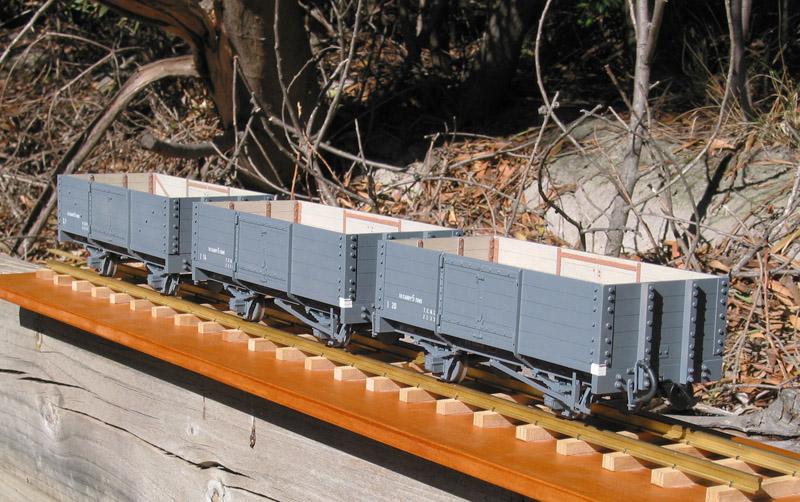
This one shows all three models in the batch. The first one completed is on the left and has some details that were changed for the other ones.
This photo shows the first one completed, along with a drop side wagon and a louvre van, to give an idea of the relative bulk of these models.

TVT Story
These wagons were built as the standard general goods wagon for the TVT. Like other Aust. railways, the TVT uses mainly open wagons with tarpaulins.
The drop side wagons used as ballast wagons when the line was built have turned out to be more versatile, so no more high sided wagons will be built. They now spend most of their time carrying firewood and mine timbers, due to their larger cubic capacity.
They were tried out for loco coal traffic, but were not popular due to taking longer to unload than the drop side wagons, cutting into the coal stage crew's smoko time.
Regards,
Graeme
Just one of several projects on the shelf awaiting completion........
Construction is the usual plywood, polystyrene, etc., much the same as the drop side wagons previously described, so no work in progress photos.
The dimensions were based on an Irish 3' gauge wagon, with the details taken from a small VR open wagon, but for some reason they look bigger than they are and more like a 3' 6" wagon from one of the Aust. cape gauge systems.
This photo is a completed wagon before painting, showing the construction materials used.
This one shows all three models in the batch. The first one completed is on the left and has some details that were changed for the other ones.
This photo shows the first one completed, along with a drop side wagon and a louvre van, to give an idea of the relative bulk of these models.
TVT Story
These wagons were built as the standard general goods wagon for the TVT. Like other Aust. railways, the TVT uses mainly open wagons with tarpaulins.
The drop side wagons used as ballast wagons when the line was built have turned out to be more versatile, so no more high sided wagons will be built. They now spend most of their time carrying firewood and mine timbers, due to their larger cubic capacity.
They were tried out for loco coal traffic, but were not popular due to taking longer to unload than the drop side wagons, cutting into the coal stage crew's smoko time.
Regards,
Graeme