TVT Open Wagons

Discussion of Rolling Stock related topics should go here
Post Reply
User avatar
GTB
Driver
Driver
Posts: 1711
Joined: Sat Mar 05, 2011 2:46 pm
Location: Australia

TVT Open Wagons

Post by GTB » Sat Mar 02, 2013 9:31 am

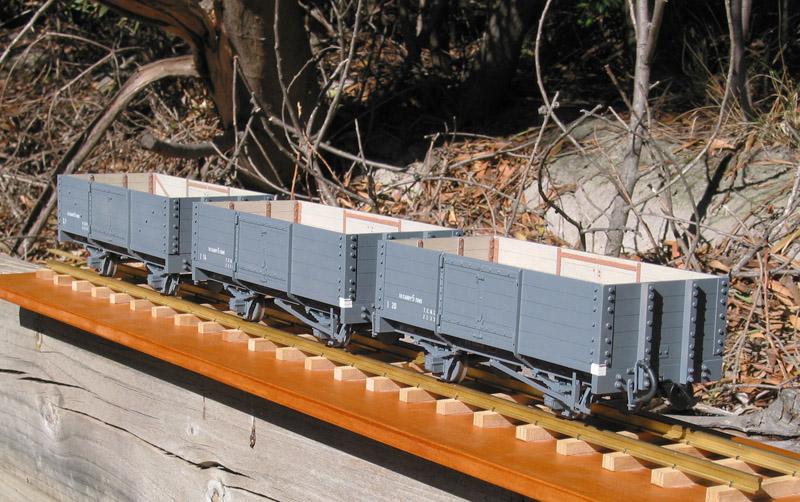
This batch of high sided open wagons has taken a while. I built the first one back in Nov. last year and had some reservations about it's proportions, so the others stayed on hold until recently, when I dusted off the parts and finished them.

Just one of several projects on the shelf awaiting completion........ :roll:

Construction is the usual plywood, polystyrene, etc., much the same as the drop side wagons previously described, so no work in progress photos.

The dimensions were based on an Irish 3' gauge wagon, with the details taken from a small VR open wagon, but for some reason they look bigger than they are and more like a 3' 6" wagon from one of the Aust. cape gauge systems.

This photo is a completed wagon before painting, showing the construction materials used.

Image

This one shows all three models in the batch. The first one completed is on the left and has some details that were changed for the other ones.
Image

This photo shows the first one completed, along with a drop side wagon and a louvre van, to give an idea of the relative bulk of these models.

Image


TVT Story

These wagons were built as the standard general goods wagon for the TVT. Like other Aust. railways, the TVT uses mainly open wagons with tarpaulins.

The drop side wagons used as ballast wagons when the line was built have turned out to be more versatile, so no more high sided wagons will be built. They now spend most of their time carrying firewood and mine timbers, due to their larger cubic capacity.

They were tried out for loco coal traffic, but were not popular due to taking longer to unload than the drop side wagons, cutting into the coal stage crew's smoko time.

Regards,
Graeme
User avatar
tom_tom_go
Driver
Driver
Posts: 4824
Joined: Wed Feb 23, 2011 3:08 am
Location: Kent, UK
Contact:

Post by tom_tom_go » Sat Mar 02, 2013 2:08 pm

Works of art Graeme!

The unpainted wood planking inside the wagons looks great.

User avatar
Chris Cairns
Driver
Driver
Posts: 2372
Joined: Mon Oct 29, 2007 7:25 pm
Location: Glasgow, Scotland

Post by Chris Cairns » Sat Mar 02, 2013 6:51 pm

Some very nice wagons Graeme.

What is the purpose of having some of the bottom corners painted white?

Chris Cairns.

User avatar
GTB
Driver
Driver
Posts: 1711
Joined: Sat Mar 05, 2011 2:46 pm
Location: Australia

Post by GTB » Sun Mar 03, 2013 4:11 am

Chris Cairns:80757 wrote: What is the purpose of having some of the bottom corners painted white?
The TVT follows Victorian Railways practice and the white patches indicate to shunters where the handbrake is located on a goods wagon, to reduce accidents in shunting yards.

There is a white square on each end of the wagon on the handbrake side and one on the side with the handbrake at the handbrake end. The first wagon has been put on the track with the handbrake on the other side, so the patches are out of sight.

It was only used on wagons with handbrakes on one side, but the VR used continuous brakes on goods trains from the 1880s, so rarely fitted a lever on both sides. Three patches of white paint were a lot cheaper than a second brake lever and a clutch mechanism.......

Graeme

IrishPeter

Post by IrishPeter » Mon Mar 04, 2013 12:22 am

3' gauge wagons are not a lot smaller than standard gauge in the UK.  The standard coal wagon c. 1900 was 15'6" over headstocks, 7'6" wide on a 9' wheelbase, held 10 tons, and weighed about 4 tons tare.  Covered wagons of the same period are about 15'6" by 7'6" by 11'6" with a tare of 4-10-0 or thereabouts.

The average for IMR 3' gauge open wagons was 14' over the headstocks, 6'6" wide and rode on a 8' wheelbase, held 6 tons and was about 2-10-0 tare!  The IMR also found the 2 plank dropside wagon the most useful type and owned no less than 78 of them as opposed to 46 centre door three-plank wagons, 19 covereds and around 25 cattle vans.  The 2=plank drop sided wagon - referred to as a 'M' wagon on the IMR - carried everything from lead ore in sacks, manure, "night soil" and loco coal, through to decorated floats for the Douglas Carnival, via bottled gas and farm machinery.  In summer they were often pushed into use as improptu luggage wagons with a tarpaulin thrown over the lot if the weather looked 'iffy!' Hopefully the ones used for luggage had not just come off the "night soil" turn!  The 3'6" wagons on the Jersey Railway were similar in size to the IMR's.

The two 30" gauge common carriers in the UK were sharply different.  The W&LLR's equipment, apart from the passenger carriages which are close in size to the IMR's big Fs, is relative small.  I think their 4 ton opens are 10' by 6' on a 6' wheelbase - similar to the Schull and Skibbereen's bijou 3' gauge equipment.  The covereds and the cattle wagons are a little bigger being around the aize of some of the smaller Irish 3' stuff - 12'6" x 6'6" on a 6'6" wheelbase.

On the other hand the L&MVLR's two opens were 25' long, 7' wide and held a shade over 15.25 tons, whilst their covered was the same general dimensions and held about 14.75 tons.  The higher tare weight for the covered is reflected in the lower capacity as Calthrop insisted on a consistent axle loading of 5 tons for locomotives, and rolling stock.  He is quite about the consistent axle loading in that his carriages with a 'double load of passengers and luggage' (i.e.when there is a pilgimage going on) being intended to weight 20 tons and thus conform to the 5 ton/axle limit.

They are lovely models, by the way.  Again I am awed by the quality of your work in the nicest possible way!

Cheers,
Peter in AZ

Post Reply

Who is online

Users browsing this forum: No registered users and 4 guests