
While I've worked with a mate in 7.25" and then 12" gauge for years, this was my first garden scale steam loco and seemed like it would be a good introduction into building models in Fn3 scale (1:20.3).
When checked, the wheels/motion were frozen and it was rough around the edges. At home, it freed up with some penetrating oil and a bit of work, but it refused to run on air. No big deal, it was cheap and I had bought it as a retirement project in any case and the Argyle drawings were still with it.
It was partly dismantled and found to have negligible wear in the working parts, but the valve gear was completely out of whack and a lot of the bolts/screws/etc. were in bad condition. The wheels had been fitted on with Loctite and one was loose, which wasn't helping the valve events, as it was the driving axle.
After that the chassis was completely dismantled and all parts were degreased, stripped of paint, cleaned and replaced if necessary. This tray contains the parts that were replaced.

Following re-assembly, the first air and then steam trials took place early this year. The valve gear was interesting, as I've never set up Stephenson gear before and there wasn't a lot of information about timing it that I could find. Eventually I got it working OK and the chassis was ticking over on 5psi of air on the test stand.
Next the boiler was inspected and given a hydraulic test. Luckily it was found to be sound. After replacing a few boiler fittings and adding a pressure gauge it was steamed for the first time, but then wouldn't maintain pressure under load when fitted to the chassis.
That's when the burner saga started. Three burners, two butane tanks and three sizes of jet later, it had stopped howling like a banshee, lit easily, the steaming time had doubled and the gas supply still ran out before the water did.
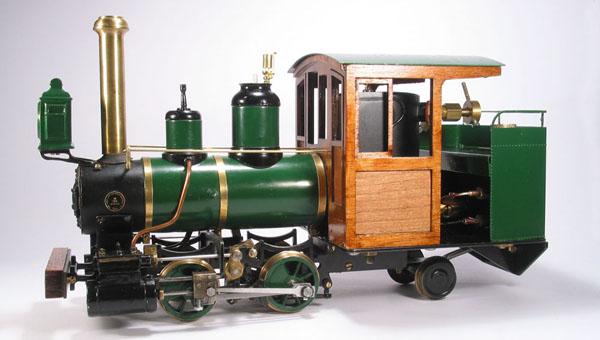
Somewhere around Easter I was happy enough with the bench running to complete the assembly and add/repair/change the detail parts to match the drawings and some prototype photos I'd found by that stage. It now looked like this.

After a more runs on the test stand, it had notched up about 2 hours running under steam and it was off to a friend's track to run trials. The photo shows it sitting over the ash pit raising steam for one of the early test runs. It took a while to get used to driving it and the final burner design was fitted around this time, which was what permanently stopped it sounding like the previously mentioned Banshee.

A few more runs and it was time to start painting. I wasn't happy with the first colour used, so it has actually been painted twice.
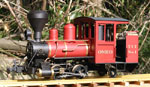
Hereabouts, Spring has sprung, the grass has riz and the littlest Baldwin sits in the afternoon sun on the edge of the jungle behind the house, to have her portrait taken.

TVT History.
The T.V.T. is the Tambo Valley Tramway. Under Victorian (the state, not the Queen) legislation, only the govt owned VR could run a railway, everything else was legally regarded as a tramway. The story is that a shire council in the area of Victoria known as East Gippsland got tired of waiting for what passed for govt. in Victoria at the time to get around to building a railway into the region. So they built their own down the Tambo River valley to wharves at the mouth of the river, making it possible for primary produce to be shipped to Melbourne by coastal shipping.
The smallest locomotive in the Baldwin narrow gauge catalog was the 6 8 1/3-C and being assembled from standard parts was available on a short lead time from Baldwin. Omeo and a sister were imported to build the tramway at about the same time as the real Fairymead Sugar Mill Baldwin locos, but the TVT was built to 3' gauge like most Victorian timber tramways, not the 2' used in the Queensland canefields. In the period modelled (late 1920's) Omeo has been long out of mainline use and is working out it's time as the depot pet at the tramway workshops. Which is why the paint is clean, the brass is polished and the lettering is gold.
Here ends the story of the littlest Baldwin......
Regards,
Graeme