a detail I haven't seen before
Posted: Sun Dec 20, 2015 6:28 am
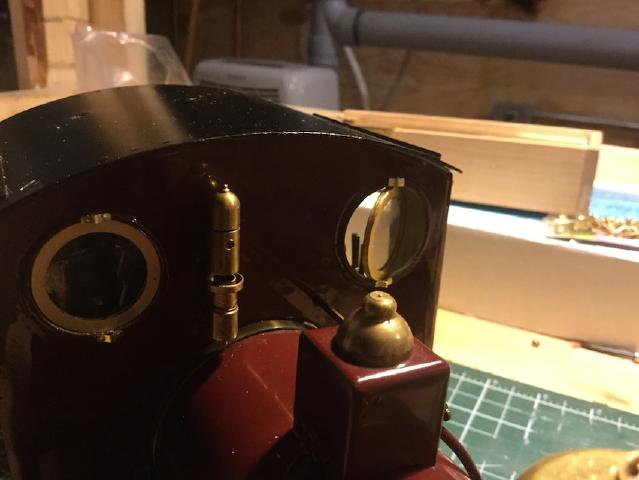
I've been fiddling with my "Billy" again. I just joined the 16mm association and the magazines with all their pictures of engines inspired me to have another go at poor "Billy". This time, I did a few things, one of which is something I've not seen before, but makes a difference to the engine. I'm sure I'm not the first one to think of it, but I've not seen it on anyone else's engine. First though, made very small covers for the swivelly bits on the spectacle rings. I noticed on real engines the opening spectacles have a plate of sorts that covers the pin upon which the ring swivels. I had difficulty soldering the rings onto the cab and more or less obliterated the little raised areas on the Swift Sixteen rings, so I made these out of very thin sheet brass. Close up they look a little rough but they are only about 1x3 millimetres, and this is approaching the limit of my ability to see well enough to work on. From a foot away they look fine.
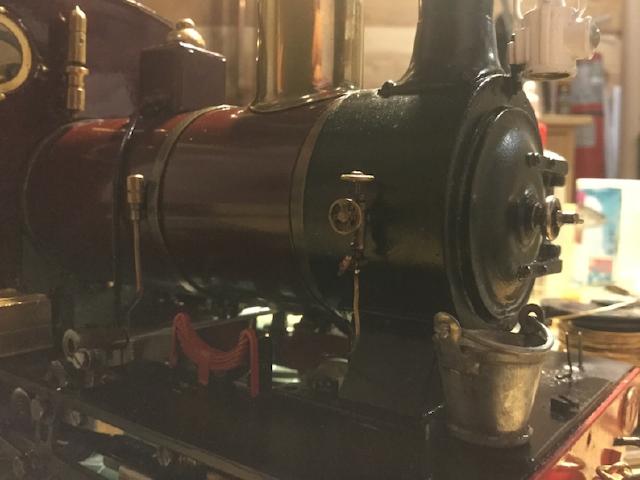
the next thing I did was to take off the dummy lubricators on the smokebox, and I drilled a little hole in the bottom of each one and soldered a bit of thin wire into them, to represent drain tubes. Now rather than draining imaginary condensate onto the running boards, it goes onto the track bed where it belongs.
Now here is the thing I don't think I've seen before. You see, on the original unaltered cab, there was a metal bracket that supported the front of the coal bunker/tank on each side. The other thing this piece of metal did was occlude one's view of the bottom of the boiler where it entered the cab. Since I removed these parts, there is now a space under the boiler that is visible. On a real engine, or a coal-fired model, you would see the throat-plate of the firebox in this space. On regular tank engines you can't see this, but on tender engines or saddle-tank engines you can. On gas-fired models, there is very often just a space under the boiler, which you would never see on a real engine. Therefore, I made a dummy throat-plate out of very thin brass. I used a punch to simulate stay-bolts and painted it a greyish colour. I am planning on weathering this part when I have the opportunity to buy some paints, with a rusty/greasy matte black. Hopefully I can make it look streaky and dirty, which will be good because a lot of engines are clean enough, but I imagine this particular part is always reasonably filthy. It is rather difficult to photograph.
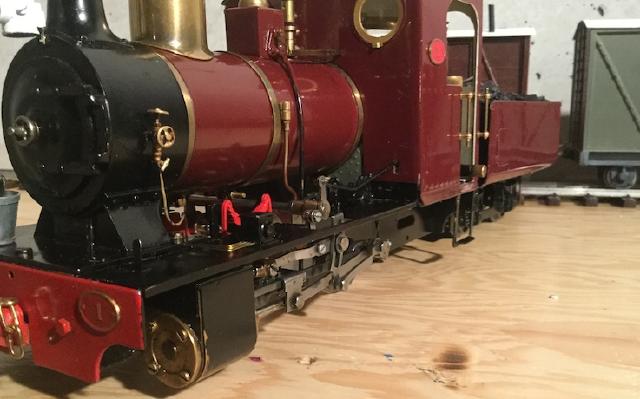
Here is an overall picture of the locomotive as it looks right now. It's rather difficult to notice the dummy throat-plate most of the time, but now I know it's there, it makes a difference to how the engine looks, to me anyway. I also have the parts to make a roof hatch and a scale chopper-style front buffer, although I am having trouble making up my mind whether this will actually look nicer than the Roundhouse one.

the next thing I did was to take off the dummy lubricators on the smokebox, and I drilled a little hole in the bottom of each one and soldered a bit of thin wire into them, to represent drain tubes. Now rather than draining imaginary condensate onto the running boards, it goes onto the track bed where it belongs.
Now here is the thing I don't think I've seen before. You see, on the original unaltered cab, there was a metal bracket that supported the front of the coal bunker/tank on each side. The other thing this piece of metal did was occlude one's view of the bottom of the boiler where it entered the cab. Since I removed these parts, there is now a space under the boiler that is visible. On a real engine, or a coal-fired model, you would see the throat-plate of the firebox in this space. On regular tank engines you can't see this, but on tender engines or saddle-tank engines you can. On gas-fired models, there is very often just a space under the boiler, which you would never see on a real engine. Therefore, I made a dummy throat-plate out of very thin brass. I used a punch to simulate stay-bolts and painted it a greyish colour. I am planning on weathering this part when I have the opportunity to buy some paints, with a rusty/greasy matte black. Hopefully I can make it look streaky and dirty, which will be good because a lot of engines are clean enough, but I imagine this particular part is always reasonably filthy. It is rather difficult to photograph.
Here is an overall picture of the locomotive as it looks right now. It's rather difficult to notice the dummy throat-plate most of the time, but now I know it's there, it makes a difference to how the engine looks, to me anyway. I also have the parts to make a roof hatch and a scale chopper-style front buffer, although I am having trouble making up my mind whether this will actually look nicer than the Roundhouse one.
