

Although you can't beat:



Your algebra is better than that in the book, They have confused pounds and tons somewhere along the line.Stuvon:78779 wrote:Right... N = Number of coupled axles, T = Tractive Force, L = Load on coupled Axles.Narrow Minded:78773 wrote:Extract from my copy of the "LOCOMOTIVE ENGINEERS POCKETBOOK" (dated 1926)
Taken from the above book:
N= 5T
2240L
for those that don't like algebra, (sorry if I have over simplified this) this means:
N = (5xT)
(2240xL)
By multiplying both sides by (2240xL) this can be rewritten as:
N x 2240 x L = 5 xT
Dividing both sides by 5 gives:
N x 448 x L = T
or
N x L x 448 = T
Now assuming no leading or trailing axles ie 0-?-0
NxL (number of coupled axles x Load on coupled axles) = Loco Weight.
Therefore:
(Loco Weight in Tons) x448 = Tractive force in Tons (assuming the coefficient of friction is 0.2)((taken from book above))
Therefore assuming the weight of the loco does not change it does not matter if the centre drivers of a Lady Ann touch or not the Tractive force is the same ;)
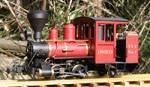
I did some experiments on drawbar pull last year and the results matched what would be predicted by the Coulomb model of friction, so it is near enough for practical purposes.Boustrophedon:84299 wrote:Assuming classical friction.........
<snip>
I own neither so I will leave real world experiments to others.
I was assuming an articulated joint not on the crank pin as per full sized. Doing it that way doubles the load on each bearing surface on each rod on the centre pin. Poor little crank pin.GTB:84351 wrote:I did some experiments on drawbar pull last year and the results matched what would be predicted by the Coulomb model of friction, so it is near enough for practical purposes.Boustrophedon:84299 wrote:Assuming classical friction.........
<snip>
I own neither so I will leave real world experiments to others.
In garden scale I got a co-efficient of friction for steel wheels on brass rail of ~0.2. These little steam dragons have a habit of spreading oil far and wide and that result is close to the quoted static co-efficient of friction for greasy surfaces.
It would be interesting to know if the Coulomb model still applies to very small scales. I know it still applies in HO, as I've done the tests in the past. I've seen a working steam locomotive built to a scale of 1:240 running on a circular track, but it was running light. I can't imagine it developed a lot of drawbar pull, although it hauled itself around as well as any electric model does in that scale.
My reservation with sprung Roundhouse chassis is that the coupling rods are articulated by using a lap joint in the rods on the centre crank pin. The individual bearing surfaces are very narrow on that pin and with reciprocating forces there is no guarantee that both halves of the joint are sharing the bearing load equally all the time. I've seen this sort of joint wear very quickly in HO in the past. I have one sprung Roundhouse loco and one unsprung, so I guess I'll find out eventually.
Graeme
Yes, I saw him running them at an AMRA Exhibition in Sydney back in the late '70s. See is a relative term. Even that far back I had trouble clearly seeing something that small.Keith S:84366 wrote:Graeme, did you SEE one of A.Sherwood's little live steam engines?
Users browsing this forum: No registered users and 22 guests
