Page 3 of 3
Posted: Sun Feb 12, 2012 4:05 pm
by Steven.T
The tender is slightly lower than the cab footplate, larger wheels would make this level, probably helping with the buffer height aswell, it would be much closer!
Roundhouse seem to think the bufferbeam may be faulty, however it may be quite costly to replace all the etches!
The loco buffer (correct height) compared to Tender (low):

Footplates:

Steven
Posted: Sun Feb 12, 2012 5:03 pm
by TonyW
Many thanks Steven ... that is quite a difference!
Looking at this picture and the others you have posted here, your tender buffer beam looks to be narrower than normal in that it is only the width of the frames. All of the George tenders I have built have had a full width buffer beam (as wide as the body) and take the standard rivetted etch that you have put on the loco. This picture shows a full-width buffer beam on the tender too:

Is the narrow buffer beam something that you asked for specifically? Where did it come from?
I've just measured a standard full-width buffer beam from a George tender that I have here. The distance from the top of the buffer beam to the top of the coupling cut-out is 14.5mm. If it is easier, the distance from the top of the buffer beam down to the top of the coupling body is 10mm. The top of the hook is just about level with the top of the buffer beam.
Is it possible for you to measure yours?
Posted: Sun Feb 12, 2012 8:52 pm
by Keith S
I don't think this is a new problem. I have a kit built "Billy" with a "William" tender, and I've just checked the buffer heights on them. The tender kit came with a narrow buffer beam like Steven's, and the locomotive frame came with the wide ones. The wide one stayed on the loco when I built it, as the cab steps are meant to fit onto the buffer beam on "Billy".
I suspect the "George" uses the same locomotive frame as "Billy", and the tender uses the same frame as "William", so look at this:

I believe the engine in the factory picture is the prototype, but now they are supplying the tenders with the narrow buffer beam from the "William" tender.
At any rate, this shows that the tender buffer beams have always been lower than the locomotive's. I would be interested if this is the case on the "William" locomotive.
You can see in the pictures that the loco frames and the tender frames are not equal height, even though the bodies match up. In the "george" prototype picture it even seems to me as though the rear buffer beam is closer to the rail than the front one is.
Wouldn't be too hard to fix, but I bet there are a lot of Roundhouse engines with tenders whose buffers are at different heights!
Posted: Sun Feb 12, 2012 10:08 pm
by Steven.T
Thanks for the reply Keith/Tony.
Tony, there was no full size bufferbeam with the tender, it was factory fitted to the loco, I thought there maybe should have been one on the tender but wasn't sure, I will include this in the letter when I send the tender back to Roundhouse.
I'll get the measurements for you tomorrow, but at a quick glance the hook is definitely not at the same level, and the cut out is roughly half way down the beam.
I think it could be fixed by cutting the 'cut out' further up the buffer beam, bending the metal back and drilling and fixing the buffer in the higher place.
I think I will include a print out of this conversation when I send it to Roundhouse, if that is O.K. with you guys.
I can't see how the kit for the Tender and the R-T-R model would be different in these respects!
Thanks
Steven
Posted: Sun Feb 12, 2012 10:41 pm
by Keith S
No, I don't think the kit or the RTR ones would be different. I just mentioned it was a kit because I would have had the option of a long or short buffer beam by swapping with the locomotive.
I think that Roundhouse uses the same steel strip to make the tender frames and the loco frames, but since the locomotive wheels are bigger the tops and bottoms of the frames are not equal height. They are using buffer beams that fit onto either loco or tender, so the tender coupler height ends up being lower. The solution is obviously what you said, just making dedicated tender buffer beams with the slots cut higher to raise the buffer to the correct height.
Having said all that, I must say I had noticed the buffer on the engine was lower than the buffers on my I.P. wagons, but it never bothered me enough to check the buffer height on the other side of the engine! To be honest, it still doesn't bother me very much, although if Roundhouse makes a tender beam that raises the buffer height, I will buy one.
Posted: Tue Apr 03, 2012 12:05 pm
by TonyW
ste234:66368 wrote:Tony, there was no full size bufferbeam with the tender, it was factory fitted to the loco, I thought there maybe should have been one on the tender but wasn't sure, I will include this in the letter when I send the tender back to Roundhouse.
Steven, can I ask if this is now resolved? If so, how? I appear to have a similar problem....!
Posted: Tue Apr 03, 2012 12:48 pm
by Steven.T
Hi Tony, yes the issue has now been resolved. There is a guy at the model engineering club I go to who works at Roundhouse, he took the tender away, put a new bufferbeam on and fixed the buffer height issue. I think I uploaded some photos of it to the forum.
I think your best port of call may be to contact Roundhouse directly and see what they say.
Have you been treating yourself?
Cheers,
Steven
Posted: Tue Apr 03, 2012 1:08 pm
by TonyW
Thanks Steve, much appreciated! I shall probably do the same and make a new rear beam.
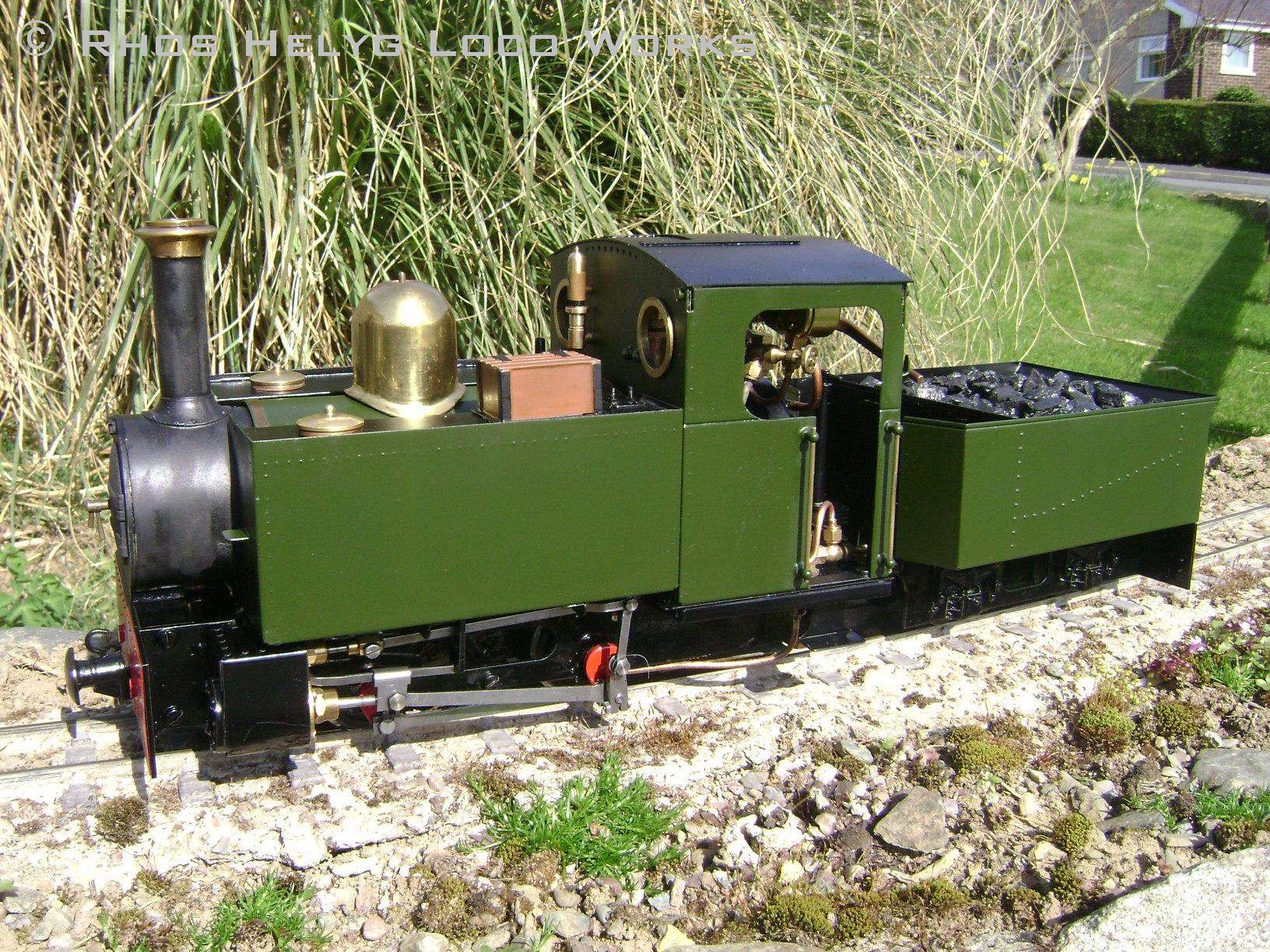
No treating this time! It is a customer's modified DJB Robert that I have put together, painted and tested for him. He wanted a tender and the George tender was the obvious choice.
You can see a picture of the (nearly!) finished loco here:
http://www.rhoshelyg.me.uk/Pictures/DSC02354.JPG
Posted: Tue Apr 03, 2012 5:06 pm
by Keith S
That is a beautiful engine.
Posted: Fri May 04, 2012 9:35 pm
by Steven.T
Just recieved my 2 "Osprey" nameplates from MDC today, very impressed with them! Haven't trial fitted them to the engine yet, but they are lovely little things!