Here is an uninteresting locomotive apparently
Posted: Sat Feb 26, 2011 10:13 pm
I thought some of you would like to see this locomotive. I gather that most here (including me) are working with British-looking engines, so this one will be a little different. I hope it's OK to post lots of pictures.
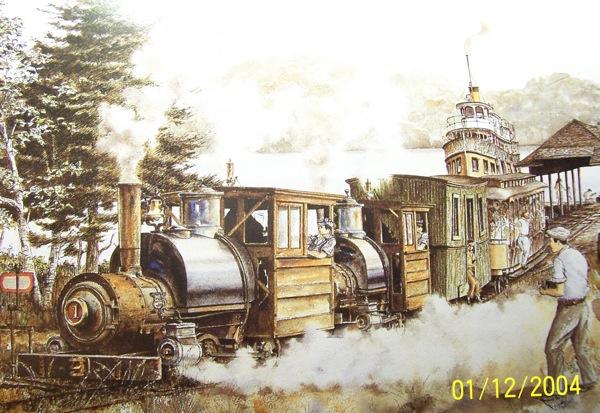
A while ago, my brother sent me a card with a railway scene on it. It was a painting of the "Huntsville and Lake of Bays Railway" from Ontario, Canada. My father has an entire book on the subject of this railway, but briefly, it was the world's shortest commercial railway, at one mile long, and served to carry the passengers and cargo from one steam ship to another across a portage between lakes. The original motive power was two little Porter 0-4-0 tank engines, which worked until 1949, when they both failed boiler inspections and were replaced with two larger MLW 0-4-0 engines. These ran until the mid-fifties when the steam ships were retired. Rolling stock was a couple of open coaches made from retired TTC horse drawn streetcars, and a few home made box and flat wagons. The picture depicts the original Porter engines.
I thought "this would make an ideal garden railway". But I don't have a garden and was already working on the "Billy" kits. Then, on a different steam discussion forum, someone posted a video of a small live steam Porter running on 45mm track. It made me think of the picture my brother had sent me. Then one day I saw one for sale on EBay, and bought it. It was quite reasonable and looked pretty good, except the wood burner chimney was not the same as the H&LB engines. My intention was to give the locomotive to my Father as a gift. He lives in Ontario, and although he loves trains, does not presently have an outdoor railway or any live steam engines.
I have since become aware that this particular engine (made by "Bowande" or "Wuhu" in china) has been the subject of an industrial espionage controversy. The person responsible for its construction is apparently a former chinese employee of Accucraft, and the story is that Accucraft management find the design of this engine close enough to their Ruby 5 "Porter" that they have ordered the other company to cease and desist. The one on Ebay was apparently the last one available, so it seems that at serial number 18, it is a bit of an oddball in the locomotive world. I don't have much to say about its origins other than there are some very similar components to Accucraft engines, but there are other things, including its overall size, that are not the same at all. Considering it is built to emulate a specific prototype, it's difficult for me to say whether some of the similar features are pirated designs, or simply the result of the original full size design or the necessities of making such a small steam locomotive functional.
Anyway, when I received the locomotive, I was quite impressed with the quality and detail of its construction. I thought the chimney was a little skinny, but figured that if Dad didn't like it he could change it to look like a coal burner chimney. This becomes important later. The rest of the model is quite good. It has sprung wheels, and very fine detail etched or cast into the brass parts. The whole thing is brass, with the exception of a copper boiler, steel wheels and frame and stainless rods. It is made of good thick metal and is solidly built with some neat details, especially for such an inexpensive engine. (the equivalent of 286 pounds)
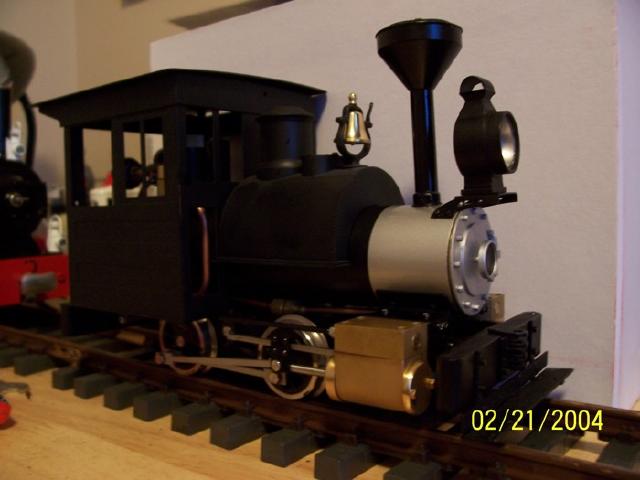
It is when I tried to steam the engine that I began to have trouble. I know this might be a little like giving someone a box of chocolates with one missing, but I wanted to be sure that the engine was a runner before I gave it to my Dad. I'm hoping he likes it enough that it will induce him to build a railway in his garden.
I noticed that, while the burner was easy enough to light, and the boiler came up to pressure quickly, it would not stay lit with the smokebox door closed, especially when the engine was just starting and making lots of condensate. I was eventually able to get it to run on blocks with the burner very carefully set, and the engine running without condensate before shutting the door, but it would still flame out for no particular reason a couple of times per run. I also found it rather anemic and sputtery. I chalked this up to it needing a good breaking-in, but the burner bothered me. I began to realise that all the videos I had looked at of these engines running on track had the smokebox doors slightly ajar. I had thought this was just oversight on the part of the owners but now I began to see that it was the only way to keep the burner lit. Then I noticed how hot it was under the engine and realised that most of the burner exhaust was coming out the drain hole under the smokebox. A hand over the chimney told me there was only steam coming out and no smoke. I realised that the chimney was so thin, even a drop of condensate would completely choke it, restricting the steam exhaust, and completely blocking the smoke. In fact, I believe that there was little to no fire exhaust going up the chimney in the first place. I tested this theory by completely removing the chimney: The burner performed perfectly and the engine ran better!
Therefore, I decided to make a new, wider chimney. I soldered a flange onto a piece of copper pipe, and used small copper brads and high-temp epoxy to secure it to the smokebox. I would have used screws, but didn't have a tap small enough to thread the holes. Then just for decoration, I force fit a brass bushing to the top. I think it looks like a spark arrestor and moves the visual centre of gravity of the engine forward, away from the gigantic cab.
Here is the result: ( I always seem to forget to latch the cab roof before taking pictures )
)
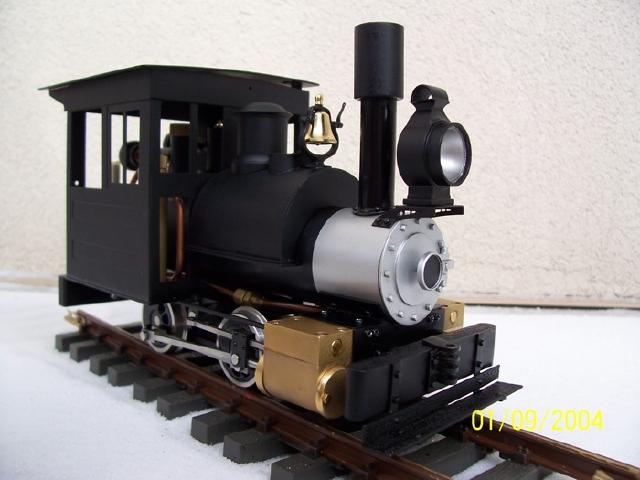
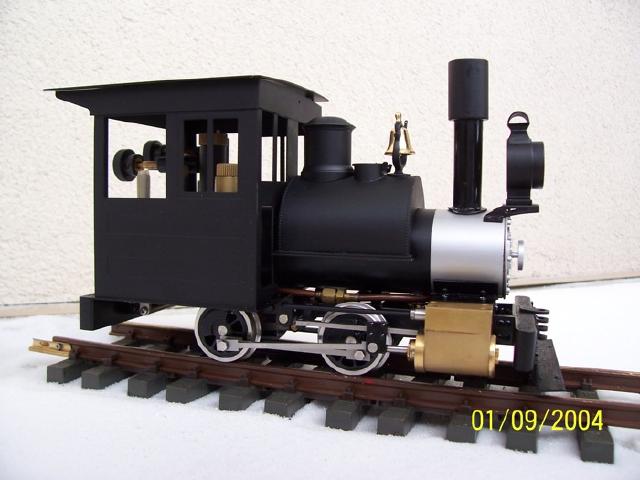
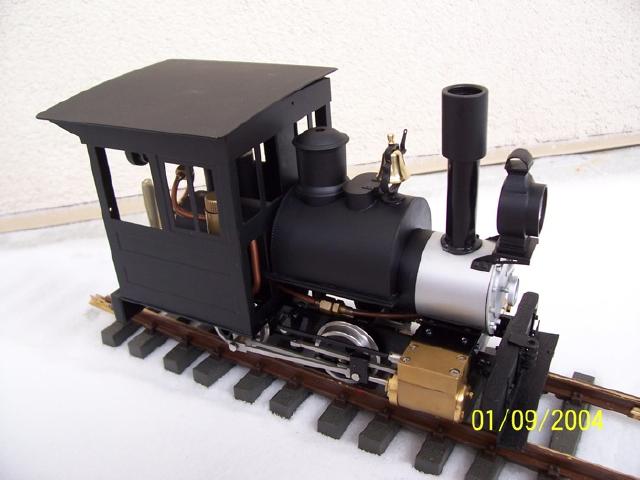
I think it makes the locomotive look "industrial". It's probably a matter of taste: some of you will find it ugly. I hope my Dad doesn't: it won't come off!
The good part is how much better the engine runs. It has much more power, and the exhaust plume, now that all the fire exhaust is going out the chimney along with the steam, has turned from a weak wisp to a huge plume. The bushing on top acts as a bit of a chuff pipe, and the engine makes a strong exhaust beat. The chimney is hotter, and therefore condensate production is much reduced, and the fire roars away no matter how high or low it is set, with the smokebox door firmly CLOSED. It will tick over on blocks like a traction engine, or roar away at a ridiculously high speed, and now that there is no restriction to the exhaust, the regulator has a much greater range. The engine is completely transformed.
It is very small. here it is compared to the "Billy". "Billy" seems like a giant monster after working on the little Porter.
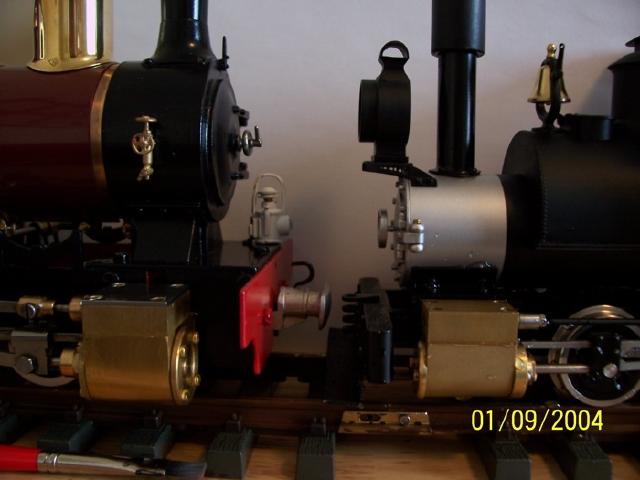
Due to the incredibly small boiler, it does not run for very long: Maybe ten minutes. But it steams up in under three minutes, so re-filling it shouldn't be too bothersome.
The engine is cleaned up and ready to be sent to Ontario, yet I find myself reluctant to part with it. It has really grown on me. Of course once it was steaming properly I completed the break-in period, so it is at its best when my Dad fires it up.
This is all part of a strategy to make my Dad build a railway, so that I will have someplace to run my "Billy" when I visit.
A while ago, my brother sent me a card with a railway scene on it. It was a painting of the "Huntsville and Lake of Bays Railway" from Ontario, Canada. My father has an entire book on the subject of this railway, but briefly, it was the world's shortest commercial railway, at one mile long, and served to carry the passengers and cargo from one steam ship to another across a portage between lakes. The original motive power was two little Porter 0-4-0 tank engines, which worked until 1949, when they both failed boiler inspections and were replaced with two larger MLW 0-4-0 engines. These ran until the mid-fifties when the steam ships were retired. Rolling stock was a couple of open coaches made from retired TTC horse drawn streetcars, and a few home made box and flat wagons. The picture depicts the original Porter engines.
I thought "this would make an ideal garden railway". But I don't have a garden and was already working on the "Billy" kits. Then, on a different steam discussion forum, someone posted a video of a small live steam Porter running on 45mm track. It made me think of the picture my brother had sent me. Then one day I saw one for sale on EBay, and bought it. It was quite reasonable and looked pretty good, except the wood burner chimney was not the same as the H&LB engines. My intention was to give the locomotive to my Father as a gift. He lives in Ontario, and although he loves trains, does not presently have an outdoor railway or any live steam engines.
I have since become aware that this particular engine (made by "Bowande" or "Wuhu" in china) has been the subject of an industrial espionage controversy. The person responsible for its construction is apparently a former chinese employee of Accucraft, and the story is that Accucraft management find the design of this engine close enough to their Ruby 5 "Porter" that they have ordered the other company to cease and desist. The one on Ebay was apparently the last one available, so it seems that at serial number 18, it is a bit of an oddball in the locomotive world. I don't have much to say about its origins other than there are some very similar components to Accucraft engines, but there are other things, including its overall size, that are not the same at all. Considering it is built to emulate a specific prototype, it's difficult for me to say whether some of the similar features are pirated designs, or simply the result of the original full size design or the necessities of making such a small steam locomotive functional.
Anyway, when I received the locomotive, I was quite impressed with the quality and detail of its construction. I thought the chimney was a little skinny, but figured that if Dad didn't like it he could change it to look like a coal burner chimney. This becomes important later. The rest of the model is quite good. It has sprung wheels, and very fine detail etched or cast into the brass parts. The whole thing is brass, with the exception of a copper boiler, steel wheels and frame and stainless rods. It is made of good thick metal and is solidly built with some neat details, especially for such an inexpensive engine. (the equivalent of 286 pounds)
It is when I tried to steam the engine that I began to have trouble. I know this might be a little like giving someone a box of chocolates with one missing, but I wanted to be sure that the engine was a runner before I gave it to my Dad. I'm hoping he likes it enough that it will induce him to build a railway in his garden.
I noticed that, while the burner was easy enough to light, and the boiler came up to pressure quickly, it would not stay lit with the smokebox door closed, especially when the engine was just starting and making lots of condensate. I was eventually able to get it to run on blocks with the burner very carefully set, and the engine running without condensate before shutting the door, but it would still flame out for no particular reason a couple of times per run. I also found it rather anemic and sputtery. I chalked this up to it needing a good breaking-in, but the burner bothered me. I began to realise that all the videos I had looked at of these engines running on track had the smokebox doors slightly ajar. I had thought this was just oversight on the part of the owners but now I began to see that it was the only way to keep the burner lit. Then I noticed how hot it was under the engine and realised that most of the burner exhaust was coming out the drain hole under the smokebox. A hand over the chimney told me there was only steam coming out and no smoke. I realised that the chimney was so thin, even a drop of condensate would completely choke it, restricting the steam exhaust, and completely blocking the smoke. In fact, I believe that there was little to no fire exhaust going up the chimney in the first place. I tested this theory by completely removing the chimney: The burner performed perfectly and the engine ran better!
Therefore, I decided to make a new, wider chimney. I soldered a flange onto a piece of copper pipe, and used small copper brads and high-temp epoxy to secure it to the smokebox. I would have used screws, but didn't have a tap small enough to thread the holes. Then just for decoration, I force fit a brass bushing to the top. I think it looks like a spark arrestor and moves the visual centre of gravity of the engine forward, away from the gigantic cab.
Here is the result: ( I always seem to forget to latch the cab roof before taking pictures
)I think it makes the locomotive look "industrial". It's probably a matter of taste: some of you will find it ugly. I hope my Dad doesn't: it won't come off!
The good part is how much better the engine runs. It has much more power, and the exhaust plume, now that all the fire exhaust is going out the chimney along with the steam, has turned from a weak wisp to a huge plume. The bushing on top acts as a bit of a chuff pipe, and the engine makes a strong exhaust beat. The chimney is hotter, and therefore condensate production is much reduced, and the fire roars away no matter how high or low it is set, with the smokebox door firmly CLOSED. It will tick over on blocks like a traction engine, or roar away at a ridiculously high speed, and now that there is no restriction to the exhaust, the regulator has a much greater range. The engine is completely transformed.
It is very small. here it is compared to the "Billy". "Billy" seems like a giant monster after working on the little Porter.
Due to the incredibly small boiler, it does not run for very long: Maybe ten minutes. But it steams up in under three minutes, so re-filling it shouldn't be too bothersome.
The engine is cleaned up and ready to be sent to Ontario, yet I find myself reluctant to part with it. It has really grown on me. Of course once it was steaming properly I completed the break-in period, so it is at its best when my Dad fires it up.
This is all part of a strategy to make my Dad build a railway, so that I will have someplace to run my "Billy" when I visit.