After getting the indoors section of my line to a state of relative completion in terms of being able to run trains I now need to plan my outdoor section.
I am going for a boards on posts approach and after a bit of eyeing stuff up in the garden today I have realised quite how far off the ground the far end of the line will end up.
I wonder what people generally would recommend as a ruling gradient for straight sections of line. I should have at least a 50 foot straight run in which to bring the line down in - perhaps even another 20 feet or so depending on how I configure it so should be able to achieve something relatively gentle.
Your thoughts/experience would be much appreciated!
Allowable Gradients
-
steamyjim
- Retired Director

- Posts: 1210
- Joined: Tue Oct 16, 2007 9:19 pm
Allowable Gradients
Check out my steam and engineering youtube channel at...
https://www.youtube.com/channel/UC8vX4P ... _PnvhldjjA
https://www.youtube.com/channel/UC8vX4P ... _PnvhldjjA
-
IrishPeter
When it comes to gradients, the conventional wisdom for live steam is "as shallow as possible" with 1 in 50 aka 2% mentioned as a maximum, which is all very well if you live somewhere flat - like Texas or Cambridgeshire.
However, faced with the somewhat mountainous terrain in my yard, I have found that with battery electrics and Roundhouse/Merlin/Beck locomotives you can get away with 1 in 27, though I have long since resigned myself to replacing certain reciprocating components - mainly drive rods - semi-regularly. Though keeping the loads down helps there, especially with the Accucraft Ruby, which has plenty of power on the flat, but is not a great hill climber.
The trick with steep gradients is to avoid sharp curves as the drag as the flanges bite on the curves is a very effective brake. This is especially true of 4-wheelers, and doubly so of long wheelbase four wheelers. Paradoxically, dead straight is not much help with steep gradients either, as there will be a tendency to run away on the down hill. As a rule, my steepest gradients are on wide radius curves.
Peter in AZ
However, faced with the somewhat mountainous terrain in my yard, I have found that with battery electrics and Roundhouse/Merlin/Beck locomotives you can get away with 1 in 27, though I have long since resigned myself to replacing certain reciprocating components - mainly drive rods - semi-regularly. Though keeping the loads down helps there, especially with the Accucraft Ruby, which has plenty of power on the flat, but is not a great hill climber.
The trick with steep gradients is to avoid sharp curves as the drag as the flanges bite on the curves is a very effective brake. This is especially true of 4-wheelers, and doubly so of long wheelbase four wheelers. Paradoxically, dead straight is not much help with steep gradients either, as there will be a tendency to run away on the down hill. As a rule, my steepest gradients are on wide radius curves.
Peter in AZ
-
Dr. Bond of the DVLR

- Retired Director
- Posts: 4533
- Joined: Tue Jun 09, 2009 9:43 pm
- Location: Suffolk
- Contact:
I suppose it depends what you want out of your railway. If a "Hands off" driver its probably best to go for flat, if you enjoy driving your locos a stiff gradient can be great fun esp if your locos are light footed. On GERick's line I visited with my Merlin Little Wonder. It plodded round most of his line just fine but there is a fierce bank which thwarted my first effort. Backing down carefully with the gas turned up and waiting a while for the pressure to build up we had a run up and made it over the summit - All excellent fun. With regards suitable gradients, then, and what it is appropriate to haul over them, should we look to the prototype railways? If so the 1 in 29 (WLLR) with three carriages and a wagon or two is possible or, 1 in 19 (Foxfield railway) with a few mineral wagons and a brake van.

The railway which people forgot
(to build)
-
robyholmes
-
Dr. Bond of the DVLR
- Retired Director
- Posts: 4533
- Joined: Tue Jun 09, 2009 9:43 pm
- Location: Suffolk
- Contact:
A little fun from 7 years ago. MHLR's rather fierce gradient was a little hair raising with a manual loco to say the least...
https://youtu.be/obcXnr4j7Lk?t=2m55s
I wonder how many forumers will remember the first time this was posted here?
https://youtu.be/obcXnr4j7Lk?t=2m55s
I wonder how many forumers will remember the first time this was posted here?
The railway which people forgot
(to build)
-
steamyjim
- Retired Director
- Posts: 1210
- Joined: Tue Oct 16, 2007 9:19 pm
Thank you for your comments. I was hoping to be able to leave trains to run, I'm a hands off runner so I shall have to minimise the gradients as far as possible.
1 in 50 has been mentioned, from experience does that generally allow manually controlled locomotives to 'look after themselves' i.e, not run away and not keep stopping.
See the diagram below, the bits where I've drawn an orange line around are where I should be able to drop the line while avoiding the curve. I'll grab some dimensions of the garden tomorrow to get a better idea.
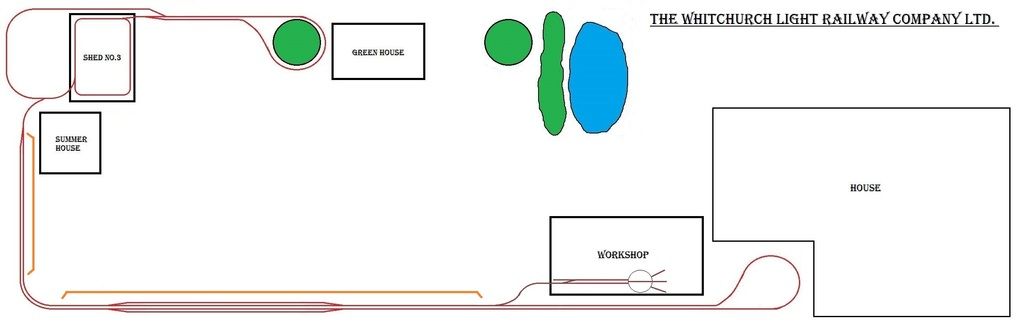
1 in 50 has been mentioned, from experience does that generally allow manually controlled locomotives to 'look after themselves' i.e, not run away and not keep stopping.
See the diagram below, the bits where I've drawn an orange line around are where I should be able to drop the line while avoiding the curve. I'll grab some dimensions of the garden tomorrow to get a better idea.

Check out my steam and engineering youtube channel at...
https://www.youtube.com/channel/UC8vX4P ... _PnvhldjjA
https://www.youtube.com/channel/UC8vX4P ... _PnvhldjjA
-
steamyjim
- Retired Director
- Posts: 1210
- Joined: Tue Oct 16, 2007 9:19 pm
I should also say that I will be mainly running live steam...
Check out my steam and engineering youtube channel at...
https://www.youtube.com/channel/UC8vX4P ... _PnvhldjjA
https://www.youtube.com/channel/UC8vX4P ... _PnvhldjjA
-
Dr. Bond of the DVLR
- Retired Director
- Posts: 4533
- Joined: Tue Jun 09, 2009 9:43 pm
- Location: Suffolk
- Contact:
-
IrishPeter
Yes, that would be an idea. Most of my longer gradients have some modest curves in them to restrain the tendency of manual locomotives to runaway down hill. Nothing sharp, six or eight foot radius should do it, but that is enough to add a wee bit of drag to stop a load getting out of hand. It helps to keep the cripples box empty.
Peter in AZ
Peter in AZ
-
Andrew
- Moderator

- Posts: 3422
- Joined: Tue Jul 03, 2012 1:33 pm
- Location: Bristol, UK
- Contact:
All sounds like sound advice to me... I've got 1 in 50 gradients but underestimated the effect of sharp curves as well. I made the sharpest curves level, but the train's still negotiating those as the loco hits the next gradient - it's quite tricky to get a smooth run! If you can give me a couple of weeks to get the track up to scratch after the recent fence-building mess then you'll be most welcome to come and try it out for yourself.
Cheers,
Andrew.
Cheers,
Andrew.
-
steamyjim
- Retired Director
- Posts: 1210
- Joined: Tue Oct 16, 2007 9:19 pm
Thank you for the tips - I had been more concerned about getting up the hill and hadn't considered too much the need for slowing them down on the way down.
Andrew, thanks for the invite, I shall be back from university early in June so would love to come and have a steam up then!
Andrew, thanks for the invite, I shall be back from university early in June so would love to come and have a steam up then!
Check out my steam and engineering youtube channel at...
https://www.youtube.com/channel/UC8vX4P ... _PnvhldjjA
https://www.youtube.com/channel/UC8vX4P ... _PnvhldjjA
-
steamyjim
- Retired Director
- Posts: 1210
- Joined: Tue Oct 16, 2007 9:19 pm
Also, what are peoples thoughts on clearance between double tracks? I'd like to be able to run anything on here so I was going to make it pretty generous. I guess I'm asking how wide should I make the baseboards. Current biggest trains will be a Cheddar Hercules with Cheddar coaches, but you never know for the future![/quote]
Check out my steam and engineering youtube channel at...
https://www.youtube.com/channel/UC8vX4P ... _PnvhldjjA
https://www.youtube.com/channel/UC8vX4P ... _PnvhldjjA
-
IrishPeter
WDLR had parallel tracks at 10' centres, so it sounds like 160mm centres would be pretty good rule of thumb in SM32. I do 1:20.3 scale/3' gauge and use 6" centres (metric only goes so far with me) which would be about a scale 10'2" which works rather well as most of passenger vehicles are about 3.5" wide.
IIRC, in the early days 6' between inside rails of parallel tracks was a fairly common measurement in 304.5mm to the foot scale, which would have given roughly 11' centre on standard gauge, and 8' on two foot gauge. However, this measurement has been widened somewhat subsequently.
Cheers,
Peter in AZ
IIRC, in the early days 6' between inside rails of parallel tracks was a fairly common measurement in 304.5mm to the foot scale, which would have given roughly 11' centre on standard gauge, and 8' on two foot gauge. However, this measurement has been widened somewhat subsequently.
Cheers,
Peter in AZ
-
steamyjim
- Retired Director
- Posts: 1210
- Joined: Tue Oct 16, 2007 9:19 pm
Thank you Peter - very helpful. I suppose the best thing to do is to err on the edge of too wide!IrishPeter:117717 wrote:WDLR had parallel tracks at 10' centres, so it sounds like 160mm centres would be pretty good rule of thumb in SM32. I do 1:20.3 scale/3' gauge and use 6" centres (metric only goes so far with me) which would be about a scale 10'2" which works rather well as most of passenger vehicles are about 3.5" wide.
IIRC, in the early days 6' between inside rails of parallel tracks was a fairly common measurement in 304.5mm to the foot scale, which would have given roughly 11' centre on standard gauge, and 8' on two foot gauge. However, this measurement has been widened somewhat subsequently.
Cheers,
Peter in AZ
Check out my steam and engineering youtube channel at...
https://www.youtube.com/channel/UC8vX4P ... _PnvhldjjA
https://www.youtube.com/channel/UC8vX4P ... _PnvhldjjA
-
Soar Valley Light

- Driver

- Posts: 1490
- Joined: Sun Dec 08, 2013 5:18 pm
- Location: North West Leicestershire
We still work to a six foot space on the Natioanl network guys, except of course where it's narrower. Places like the Cumbrian Coast come down to about 5'-6" in the platforms. That's back edge to back edge, you need to add on twice the width of rail you're using to arrive at a gauge to gauge dimension. On the standard gauge, with 3" rail head (almost), that's 6'-6".
On my own garden line I'm planning to adopt the 6'(ish) dimension and working to a 112mm gauge to gauge, that's 6'-6" gauge edge to gauge edge and about 6'-3" back edge to back edge.
Of course, each case is different and it's best to measure your stock, don't forget to allow for centre thrown and end throw (overhang in the middle and at the ends) on curves. The bottom line is make it as big as you can if you are likely to have 'open house running', to account for larger visiting vehicles.
On my own garden line I'm planning to adopt the 6'(ish) dimension and working to a 112mm gauge to gauge, that's 6'-6" gauge edge to gauge edge and about 6'-3" back edge to back edge.
Of course, each case is different and it's best to measure your stock, don't forget to allow for centre thrown and end throw (overhang in the middle and at the ends) on curves. The bottom line is make it as big as you can if you are likely to have 'open house running', to account for larger visiting vehicles.
"Smith! Why do you only come to work four days a week?
"'cause I can't manage on three gaffer!"
"'cause I can't manage on three gaffer!"
-
steamyjim
- Retired Director
- Posts: 1210
- Joined: Tue Oct 16, 2007 9:19 pm
Thank you. I think that's what I intend to do, make the line as open as I can to account for open house running - you never know when someone is going to turn up with an NGG16 and a train of bogie coaches!Soar Valley Light:117737 wrote:We still work to a six foot space on the Natioanl network guys, except of course where it's narrower. Places like the Cumbrian Coast come down to about 5'-6" in the platforms. That's back edge to back edge, you need to add on twice the width of rail you're using to arrive at a gauge to gauge dimension. On the standard gauge, with 3" rail head (almost), that's 6'-6".
On my own garden line I'm planning to adopt the 6'(ish) dimension and working to a 112mm gauge to gauge, that's 6'-6" gauge edge to gauge edge and about 6'-3" back edge to back edge.
Of course, each case is different and it's best to measure your stock, don't forget to allow for centre thrown and end throw (overhang in the middle and at the ends) on curves. The bottom line is make it as big as you can if you are likely to have 'open house running', to account for larger visiting vehicles.
Check out my steam and engineering youtube channel at...
https://www.youtube.com/channel/UC8vX4P ... _PnvhldjjA
https://www.youtube.com/channel/UC8vX4P ... _PnvhldjjA
Who is online
Users browsing this forum: No registered users and 61 guests