

I am aware that both this piston valve version, and my oscillating version, are not off the shelf production models, and have factored that into my evaluation & comparison.
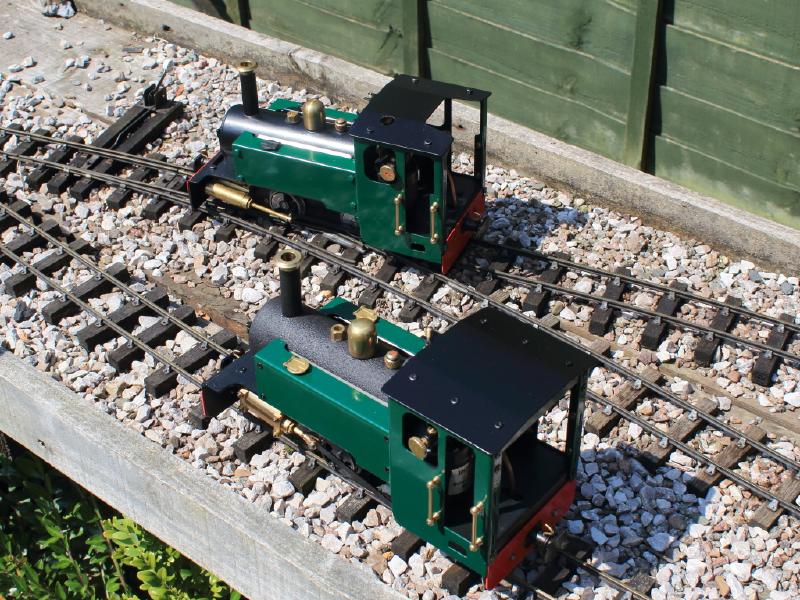
I have run the piston valve version on blocks a couple of times, and managed to run both versions at a garden railway running day last Sunday, and should be attending the same garden railway on Tuesday for another session.

Boiler – Both models have the same boiler so I was initially surprised that the piston valve version took longer to raise working pressure, and it did not have the same rattling noise that the reheat tubes cause during warming up.

Burner – From what I can work out they both have the same style burner. However with the thicker chassis frames the piston valve version is more closed in, and is also mounted approx. 4mm further down from the boiler (that explains why it is harder to see the burner when lighting up). However the piston valve version’s burner was burning with a distinct yellow flame at its front end and there was noticeable deposits being burnt off during a run on blocks.
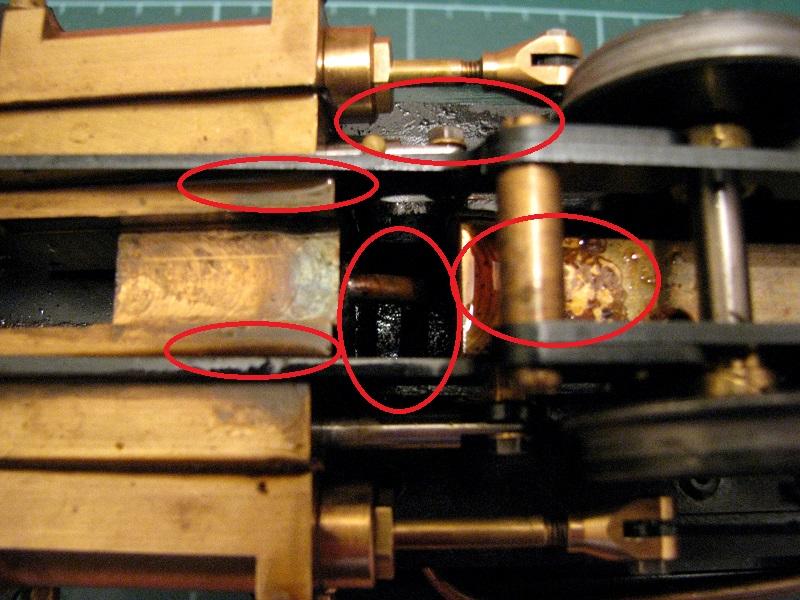
A closer look at the loco’s underneath clearly shows signs of oily condensate on the boiler bottom, front of the side tanks and this has been ‘cooked’ onto the front of the burner & combustion chamber side walls.
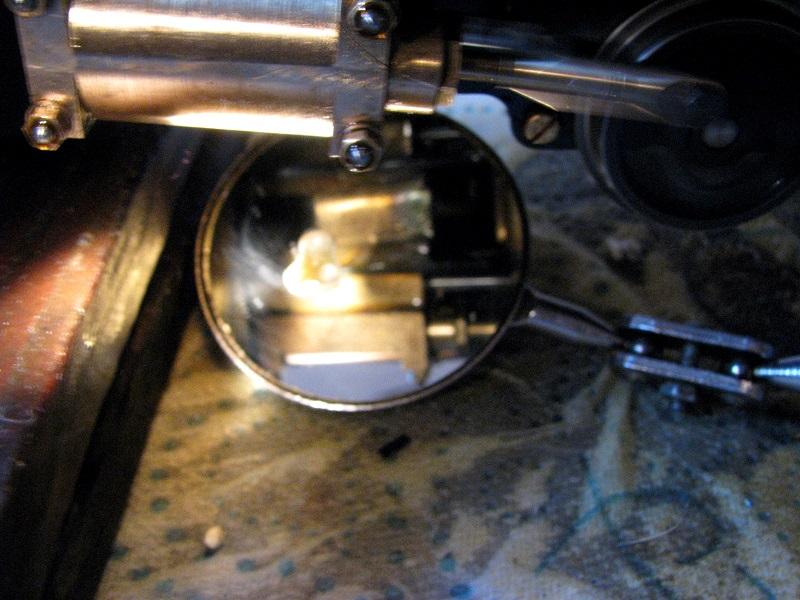
I tried to photograph the situation whilst running on blocks but ran out of hands to hold the inspection mirror, torch & manually focus the camera, but you can see the oily condensate drops on the mirror here
A further run on raised blocks indicated that there was a fair amount of oily condensate bubbly around the steam distribution block between the chassis frames. By fitting a long piece of silicon tubing to the open exhaust pipe I was able to establish that this was the oily condensate that was being expelled from the short exhaust pipe, running down through the hole in the running plate (on my oscillating version the exhaust pipe is fitted through the running plate with a grommet), then flowing down the back of that steam distribution block. The bubbly is either due to the heat of the block or a slight leak between the block & the chassis frames.

This is after the run on the garden railway, clearly showing the accumulation of oily condensate despite fitting a short piece of silicon tubing to the exhaust pipe and deep cleaning down the loco before the run
On my oscillating version I’ve fitted a Summerland Chuffer which helps with the oily condensate, although on the last run it decided to dump all the oil out of the lubricator at the beginning of the run. Its other advantage is it does not have a steam distribution block under the exhaust pipe so most of the oily condensate falls clear onto the track. For the run on the piston valve version I fitted a short piece of silicon tubing but that did not stop some of the oily condensate flowing down the back of that steam distribution block (as seen above).
We’ve been aware of the likelihood of oily condensate contaminating the ceramic burner on these pot boilered Mamods, and clearly the steam distribution block used in the piston valve version compounds the problem. Not sure there is an easy fix for this situation.
Lubricator – One of the weaknesses of earlier Mamods I was intrigued to see the inline version fitted to the piston valve version. Despite the sliding roof it is still not easy to get your fingers round the filler cap so it is good it has a slot on top for using a flat bladed screwdriver initially. The through steam pipe is mounted much higher up than comparative lubricators from other manufacturers, and has an approx. 1.4mm hole (recommended hole for use with ISO 460 steam oil is 0.5mm). I assume that it does not supply too much steam oil with that large hole (as some Accucrafts do) because there is only an approx. 2mm gap between the top of the steam pipe & the bottom of the filler cap. The lubricator has a very large capacity (my syringe needle for sucking out water is too short here), but the plain large screw fitted drain plug means it is very difficult to only drain off the water – on my first attempt it completely drained the lubricator of water & oil. So it is difficult to measure how much oil is being used per run, but certainly you should get several runs out of one top up.
Running – I was impressed with the nice smooth running of the cylinders compared to the running of my William, William II & Brunel Mark 1 cylinders. However compared to the oscillating version, the gas outlasts the water on the piston valve version, so you need a water top up during a run. My oscillating version’s run lasted 18 minutes (I’ve found the fitting of the Summerland Chuffer increases the running time), whereas the piston valve version’s run lasted just under 14 minutes (with the same load & approximately the same speed). I hope to get a second set of running times, etc. on Tuesday.
There nearly was not a comparison. Whilst backing up the oscillating version to couple onto the L & B bogie open wagon, the regulator valve jammed shut and the knob unscrewed instead. Clearly something that has not been resolved yet (I managed to free the regulator for the run and have fixed the knob back in place with Loctite). Here's a photo of the regulator for your info.

More to come after the next running comparison.

Chris Cairns

