Page 1 of 1
Gearing query
Posted: Sun Sep 27, 2015 7:56 pm
by Dannypenguin
Hi guys,
Is there out there a motor or gearbox type thingy that allows for coasting on an electric powered loco? So when you turn the power off the loco coasts like the real thing?
Would another option to have the motor and gear on a servo powered pivot that moves the motor away from the axle with command from the driver, therefore disconnecting drive?
Thanks,
Dan
Re: Gearing query
Posted: Sun Sep 27, 2015 8:15 pm
by ge_rik
Dannypenguin:113599 wrote:Hi guys,
Is there out there a motor or gearbox type thingy that allows for coasting on an electric powered loco? So when you turn the power off the loco coasts like the real thing?
Would another option to have the motor and gear on a servo powered pivot that moves the motor away from the axle with command from the driver, therefore disconnecting drive?
Thanks,
Dan
Hmmmm ... interesting question.
I suppose a motor fitted with a large flywheel would give you that sort of effect without the need for a complicated clutch/gearbox arrangement.
Not got any experience myself - so would be interested in anyone who has.
Rik
Posted: Sun Sep 27, 2015 8:41 pm
by Busted Bricks
Moving gears in and out of mesh would be hard on them. I'd probably go for some sort of a friction or magnetic coupling between motor and gearbox and use a servo to slide the motor away from the gearbox.
It won't work in a gearbox with a worm gear.
Posted: Sun Sep 27, 2015 8:47 pm
by Busted Bricks
You could try it with a belt drive - use an idler to control belt tension. Move the idler with a servo.
Posted: Sun Sep 27, 2015 9:39 pm
by Dannypenguin
Thanks for the belt idea, that seems the best, I hope to get this project on the move soon :-) anyone else have any ideas don't hesitate to post
Posted: Sun Sep 27, 2015 10:15 pm
by ge_rik
This company looks interesting
http://www.ets.cz/en/drive-units/?cur=2 ... directed=1
They make various 0 gauge chassis with a patent clutch mechanism which allows the loco to freewheel
They seem to be based in Prague
Rik
Posted: Mon Sep 28, 2015 9:09 am
by GTB
Busted Bricks:113602 wrote:
It won't work in a gearbox with a worm gear.
It can be made to work in a worm drive by using a tumbler gear between the worm and worm wheel. Back in the '80s one of the Korean brass loco builders used a worm drive gear box with a free wheel in a few models.
I was involved in importing models at the time and we refused to use it in ours, although one of the other importers did. It could turn into a disaster for the owner of a model as a heavy train on a downgrade could override the motor and the loco and train would accelerate down the grade out of control.......
Graeme
Re: Gearing query
Posted: Mon Sep 28, 2015 10:11 am
by GTB
Dannypenguin:113599 wrote:
Is there out there a motor or gearbox type thingy that allows for coasting on an electric powered loco? So when you turn the power off the loco coasts like the real thing.
I've not seen it in the garden scales, but it has been done in OO/HO.
There used to be a drive made in Sweden under the name Dyna-Drive, that used a centrifugal clutch between the motor and the gearbox and a large flywheel to store energy to simulate the inertia of a real loco. I think it is now out of production. There may be centrifugal clutches available off the shelf for r/c model cars that would do the job in large scale.
There was also an Aust. made system that used an eddy current coupling to achieve the same thing. This is also no longer available, but an eddy current coupling would be easier to scratchbuild than a centrifugal clutch.
http://www.kingstonemodelworks.com/ECDtb.html
http://model-railroad-hobbyist.com/node/15068
If you fit a loco with a free-wheel I would seriously suggest you fit remote controlled brakes. Unless you want your train to head for the shrubbery every time it encounters a curve at the bottom of a steep grade.
Otherwise the only way to stop it is to put the motor into full reverse and hope the clutch, or gearbox doesn't blow out. An eddy current coupling won't dismantle itself under that sort of load, but it will get hot.
Regards,
Graeme
Re: Gearing query
Posted: Mon Sep 28, 2015 11:03 am
by Dannypenguin
Thanks for all of the responses!

Now that seems good! Will see if they're on Youtube and do some research on whether they ship to the UK!

GTB:113609 wrote:If you fit a loco with a free-wheel I would seriously suggest you fit remote controlled brakes.
Servo operated brake gear is part of the plan
I'm hoping to also fit smoke, lights and sound too but that I'm yet to get onto yet!
Posted: Fri Oct 23, 2015 7:31 pm
by martin.retired
This is interesting. Some time ago I posted a request for info on 'hydraulic' transmissions. The eddy current units seem to be what I was looking for. There have been many posts about the problems with nylon worm/gear combos. I believe most of the problem is due to the train trying to back drive the gearbox (impossible with a worm of course). Maybe 'coasting', freewheeling or indeed the eddy current (ersatz hydraulic) transmission can provide the solution to the problem.
Posted: Sat Nov 28, 2015 5:02 pm
by Boustrophedon
The problem is the worm gear used, these are irreversible in that they don't allow the wheels to turn the motor, The advantage is that they provide braking and conveniently turn the drive through 90 degrees.
The disadvantage is because they are irreversible they are less than 50% efficient; this is of no consequence in 00 powered from the tracks, but in a battery powered loco you are wasting half the capacity of the battery and you may not get realistic slowing down unless this is programmed into the controller or you are good with the RC. A large flywheel on the motor would be one way of solving this but does not solve the inefficiency.
There is another more subtle reason for the rapid braking to be found in the speed controller, for the motor to overrun and freewheel the motor has to be open circuit. With transistor drives the emf generated in the motor by the collapsing field when the current is shut off, would destroy the transistors. To prevent this transistor drives are always protected by diodes, which effectively short the motor on overrun, this by Lenz's law, brakes the motor rather quickly. Mosfet four quadrant drives used on golf buggies etc are usually configured to shunt this energy back into the batteries to give regeneration.
I know that in aeromodelling the electric speed controllers can be programmed to give different degrees of braking to the propeller, I do not know if this practice is common on the controllers used in model trains.
Posted: Sun Nov 29, 2015 1:05 pm
by TonyW
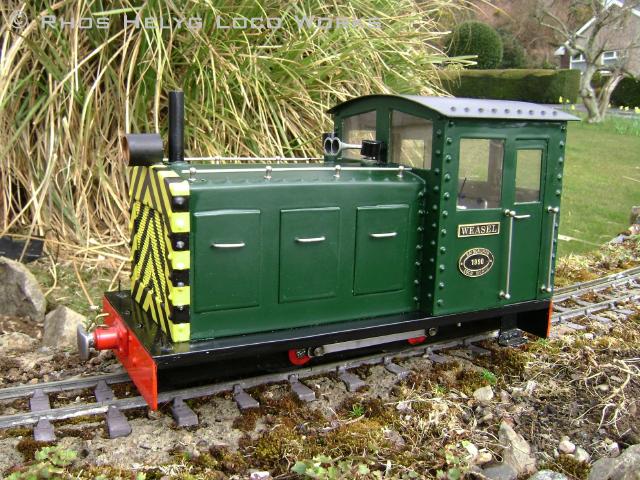
My big diesel loco accelerates away and coasts to a stand, but it is all done electronically rather than with anything mechanical. It is powered by a sealed lead-acid 12V battery driving a Como Drills motor with a worm drive to the rear axle. The wheels and axles came from Roundhouse Engineering.
The two black buttons either side of the dummy horn provide On/Off and Forward/Reverse control, and speed is governed by turning the exhaust pipe. Control is provided by an I T Electronics (Ian Titford) speed controller which gives acceleration and deceleration effects. The latter often catches out unfamiliar operators as pressing the Off button while the loco is in motion causes it to run several feet before gently coasting to a stand. The speed can be controlled right down to an almost imperceptible crawl.
Posted: Thu Dec 03, 2015 2:31 pm
by Dannypenguin
Thanks again for all of the responses.
Still undecided as to what to do - although a friend suggested an R/C car clutch if such a thing is available!