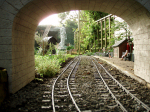
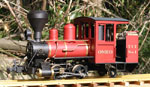
It is a while since I wrote anything about this locomotive, really because it stopped working, and it has taken me quite a while to get it to go again. I have waited until I have solved the issues before saying anything!
So it was running fine along the track and I was about to take video when it stopped in mid flow. I worked out that the valve gear was not moving in keeping with the motion. This will illustrate why:

- IMG_1488.jpg (2.13 MiB) Viewed 13903 times
The mechanism which transfers the valve motion is visible in the above photo. The cranks nearest the centre of the chassis were moving on the shaft - and losing motion. The loco would not go because the valves were hardly moving. I found some clockmakers tapered pins online which were much smaller than the 1/16 inch ones I had obtained from a model engineers supplier. The taper pin reamer I already had just happened to fit them. So the outside cranks were silver soldered to the shafts and the inner ones pinned. The benefit of the tapered pin is that a gentle hammer secures it so it won't fall out, and a tap from the other side makes it fall out. Of course as the taper is reamed into both shaft and crank it won't move either.
I was also concerned about excessive play in the valve eccentrics (they are really cams) which was caused by opening out the cam followers too much when I first built it. So I did what I should have done in the first place and made removable eccentric rods just like a car crankshaft:

- IMG_1487.jpg (1.92 MiB) Viewed 13903 times
There they are at the top of the photo. Made from rod, bored and turned, parted off, flats milled for the boltheads, drilled and tapped and finally sawn in half. On reassembly they were mounted back in the 3 jaw chuck. I used the tailstock drill chuck to push it into the main chuck squarely. Then finally bore to just under size, and polish. I thought I was cunning to use the dremmel with a polishing head and polish, while the lathe and the dremmel were both rotating. It worked, nice fit smooth motion, no sticking.
Perhaps I should have mentioned it before, but the reason this took so long was that because of the way this loco is built, with the steam and exhaust pipework inside the smokebox, it is a nightmare to disassemble and put back together. When something is this awkward to assemble it makes it 10 times more difficult to assemble it well - as in with no steam leaks. The only way to really get at these cranks which were slipping was to take the whole loco to pieces.




 but I am interested in wider aspects of engineering and design