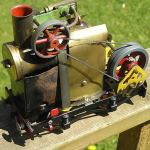
A very popular starting point for Live Steam. With their low cost comes a number of problems which can be discussed here
-
Chris Cairns
- Driver

- Posts: 2372
- Joined: Mon Oct 29, 2007 7:25 pm
- Location: Glasgow, Scotland
Post
by Chris Cairns » Mon Dec 10, 2012 3:47 pm
Thanks for this update Mike. Sadly it all sounds very familiar. It does prove that you do need to steam test them as just running on air does not highlight problems like this one.
it starts off fine but after a small while begins to run very slowly
Almost exactly the same symptoms that I suffer whilst trying to run my William II and Brunel. On the Brunel I have to fill up the lubricator after it slows down to get it to run smoothly again. Still not solved the problem with the William II. I now wonder whether a lighter grade of oil may help.
I thought they hadn't fitted O rings to their pistons up to now but was assured they did to all non-oscillators.
In the case of the Golden Jubilee & William locomotives that is not true. Have a look at this posting (scroll down to the Parts Two & Three video) where he shows you how he removed the piston gland and fitted the piston with an 'O' ring -
http://modelsteam.myfreeforum.org/ftopi ... -asc-0.php
Just checked my William II and there is an 'O' ring on the piston but it does appear to be somewhat recessed, hence my previous observation that it was just an oil ring (I had to use a magnifying glass and pin to confirm this time that there is an 'O' ring)
Chris Cairns.
-
mikewakefielduk@btinterne
Post
by mikewakefielduk@btinterne » Mon Dec 10, 2012 6:22 pm
Interesting. Clearly the O rings were introduced to try and resolve some issues but may have caused further problems. So far I haven't found my Brunel slows down after running for a while. I've checked carefully with the cylinder really hot, and the piston still seems to move extremely freely. I'm using steam oil from Mamod as the stuff I've bought elsewhere seems much thicker and treacle like.
I remain slightly baffled as to why Mamod are having an O ring problem now with the TT as you'd have thought it would be something they'd have identified at the beginning of the design process of a new loco. Unless, of course, they only made a decision to use larger cylinders quite late in the day.
Is there any feedback out there as to whether any other of their products with the non-oscillating cylinders have the same problem as the William?
Mike
-
spooner
Post
by spooner » Mon Dec 10, 2012 7:12 pm
If O rings cant roll in there slot they soon wear out.
-
Chris Cairns
- Driver
- Posts: 2372
- Joined: Mon Oct 29, 2007 7:25 pm
- Location: Glasgow, Scotland
Post
by Chris Cairns » Mon Dec 10, 2012 10:08 pm
Unless, of course, they only made a decision to use larger cylinders quite late in the day.
Which appears to be the case. Doug's visit to Mamod on 07 Nov 2012 saw the Thomas Telford with William II type cylinders and he was told it would be fitted with bigger cylinders.
By 14 Nov 2012 the larger cylinders had been fitted as seen in the Mamod YouTube video.
If you search for Mamod Centurion on the Unofficial Mamod Forum you will find Topics where owners were having problems with the cylinders. Mostly difficulty getting them to start, although at least one was having a tightness problem. The advantage of the mobile engines is they have a nice big flywheel to make slow running smoother.
The problem is that it is very difficult to get the piston gland out of the cylinder block so you cannot get access to the piston. There does appear to be problems with manufacturing tolerances of the cylinder blocks and pistons. The advantage of the old oscillating cylinders is they were easy to take apart allowing you to polish a bit off the pistons, etc.
Chris Cairns.
-
mikewakefielduk@btinterne
Post
by mikewakefielduk@btinterne » Mon Dec 10, 2012 10:31 pm
Doug's visit to Mamod on 07 Nov 2012 saw the Thomas Telford with William II type cylinders.
I presumed they made the change because of issues with the William II cylinders, but all they've done is upscale the existing design to a larger size.
The problem is that it is very difficult to get the piston gland out of the cylinder block so you cannot get access to the piston.
To me it would make manufacturing easier, and possibly cheaper, if they threaded the gland into the block and sealed it with a compressed O ring. The cylinder end and the gland could then be made with a less fine tolerance, just a thread cut into them, and wouldn't (presumably) require a press to assemble.
I do hope Mamod get to grips with this soon as they'll find themselves loosing potential business to competitors now that the William (with all its faults) and the Mk1 loco have been withdrawn. Accucraft are bringing out a small internally gas fired loco (Dora) in a couple of months with a rrp of only £380 so about £350 from dealers. Fortunately for Mamod Dora's only in 45mm gauge.
Mike
-
mikewakefielduk@btinterne
Post
by mikewakefielduk@btinterne » Wed Dec 19, 2012 3:57 pm
As I had to go to Smethwick today (to collect a parcel from the DPD depot) I took the opportunity to combine the trip with calling at Mamod, who are just around the corner.
While there I asked about the TT's progress. They're still having issues with the piston's O rings.
The cylinders are machined out to just under 11mm internal diameter and then further "punched" to remove any small burrs, to give a polished finish and to give an exact ID of 11mm.
Unfortunately they've found the nearest sized O ring has an actual diameter of 11.2mm. Ones of 11mm are listed as a standard size but no-one seems to be able to supply them.
Pistons with rings of 11.2mm bind in the bores.
They've tried re-punching the cylinders to increase the diameter hole, but this causes the cylinder wall to balloon out.
The reason they've opted for simple not using the cylinders from the William's is to provide an increase in low speed power, as the TT is quite a lot heavier.
And that's the latest other than, at some time in the future, they're looking to develop an internally gas fired loco.
Mike Wakefield
-
Chris Cairns
- Driver
- Posts: 2372
- Joined: Mon Oct 29, 2007 7:25 pm
- Location: Glasgow, Scotland
Post
by Chris Cairns » Sun Feb 03, 2013 1:24 am
So what news of the Thomas Telford then?
February was supposed to be the delivery date for the 2nd production run with the improved lubricator.
Mamod never replied to my last e-mail (I did get one answer via Mike Wakefield's visit), and their website still has the latest date for Xmas deliveries!!
Wonder what Forest Classics will be saying at the STIA exhibition later today?
Chris Cairns.
-
dougrail
- Driver
- Posts: 1535
- Joined: Mon Mar 14, 2011 5:11 pm
- Location: Salopia; on the edge of Arcadia
Post
by dougrail » Sun Feb 03, 2013 1:28 am
You going to STIA, Chris?
-
mikewakefielduk@btinterne
Post
by mikewakefielduk@btinterne » Sun Feb 03, 2013 9:17 am
I'm not sure what's going on. They're either having the cylinders honed out to take the larger than expected O rings or adapting the pistons to take different sized O rings or possibly both
From what was said when I last spoke to them I believe the current pistons are made for O rings with an expected OD of 11 mm and an ID of 7.5mm. Unfortunately the O rings they have actually have a OD of 11.2mm.
There's at least one supplier who can provide O rings with an OD of 11mm and an ID of 7mm so it may well be easier to adapt the pistons to take these rings rather than hone out the cylinders.
There's also talk of fitting a proper looking (non-opening) smoke door to the front of the boiler, which is fine if only they had a loco which worked.
Mike
-
mikewakefielduk@btinterne
Post
by mikewakefielduk@btinterne » Mon Feb 04, 2013 5:48 pm
I called Mamod this morning and spoke to Peter re. the latest status of the Thomas Telford.
It appears the 11mm diameter pistons worked but required more steam than the boiler could deliver.
Therefore the new plan is to have a small number of 10mm diameter pistons (and matching cylinders) made up. Ditto with pistons with a diameter of 10.2mm. Then further trials to see if it improves things. Timescales: week after next. I've put a note in my diary to chase them again on February 15th.
The original 11mm pistons and cylinders won't be wasted, they're destined to be used on a new stationary engine instead.
OK, so that's what Mamod told me. I must admit my patience and credibility is wearing a bit thin.
Meantime does what Mamod say seem reasonable? I just don't have the experience of live steam. Can anybody provide piston diameter and stroke dimensions for similar sized locos just to give an idea of what other manufacturers have done? I've two loco's of (presumably) a similar weight to the TT. One is an Iver and has a piston diameter of about 8mm and a stroke of 20mm. Its an oscillator, would that make a difference? The other is a Ragleth with a stroke of about 20mm and a piston diameter of 12mm. (Note, these were measured with a tape measure so could be a bit inaccurate).
Looking at the photos of the TT taken at Waverley the wheels look about the same size as a Mk11 so the stroke is going to be about the same, i.e, some 20mm.
In other words the stroke of all three locos is about the same and the 11mm diameter of the original TT pistons is in between the other two.
Any views anybody?
Mike
-
Chris Cairns
- Driver
- Posts: 2372
- Joined: Mon Oct 29, 2007 7:25 pm
- Location: Glasgow, Scotland
Post
by Chris Cairns » Tue Feb 05, 2013 1:03 pm
Thanks for getting this update Mike, and it does now sound like this loco will not be able to compete against it's bigger brothers.
Roundhouse locos are all fitted with cylinders of 9/16" bore and 5/8" stroke, and working pressure of 40PSI.
Bit harder to find technical spec on Accucraft, Joan has cylinders of bore 1/2" and stroke 3/4", and working pressure of 60 PSI. New cylinders for Ruby are 1/2" bore as well.
Wonder if this delay will affect the final price of the Thomas Telford.
Chris Cairns.
-
mikewakefielduk@btinterne
Post
by mikewakefielduk@btinterne » Tue Feb 05, 2013 3:45 pm
Thanks for the response Chris. From the info provided it looks as though other manufacturers all have cylinders with much the same capacity, or perhaps a little more, of the 11mm diameter cylinders that Mamod can't get to work properly. 11mm is certainly not vastly larger than the others so I'm wondering whether there's not something more fundamentally wrong.
I don't really understand what "running out of steam" really means. Is the water not boiling fast enough? Surely that means there's not enough heat and, if so, what difference will slightly small cylinders make? The main difference between Mamod and the others is the Mamod is the only pot boiler. Perhaps its not efficient enough.
I believe the price of £430 remains unchanged. That's assuming the loco ever finally sees the light of day of course.
Ho hum
Mike Wakefield
-
Chris Cairns
- Driver
- Posts: 2372
- Joined: Mon Oct 29, 2007 7:25 pm
- Location: Glasgow, Scotland
Post
by Chris Cairns » Tue Feb 05, 2013 4:15 pm
"Running out of steam" basically means that you are demanding a larger volume of steam than the firing method can produce, so fitting smaller cylinders will reduce the volume of steam demanded, but will also reduce the power output. Running a loco on compressed air does not suffer from this problem as you basically have an unlimited supply of compressed air!
The Roundhouse Millie is an external gas fired pot boiler which works well as an introductory level locomotive.
Problem with the current Mamods is they do not have a separate combustion chamber (rather plates riveted to the chassis) so quite a bit of the heat generated is transferred to the chassis/body and not the boiler. A proper combustion chamber, like the old Mamod SL, current MSS & Roundhouse Millie would help, or using a butane/propane gas mix as standard.
I assume the William II/Brunel cylinders are not powerful enough for the TT loco.
Chris Cairns.
-
mikewakefielduk@btinterne
Post
by mikewakefielduk@btinterne » Tue Feb 05, 2013 5:22 pm
Thanks for the response Chris. It certainly explains why the TT would run happily on compressed air but slowed down under steam after initially working fine. A pity that Mamod seemed to think it was totally being caused by excess friction from the slightly-larger-than-anticipated O rings and spending ages on fixing something which wasn't the main issue.
I can sympathise as to why they'd thought the problem was the O rings though. Peter showed me a cylinder with a "normal" O ring and you could hardly pull the piston out whereas one with the O rings lightly rubbed on emery paper and the piston slid in and out smoothly.
Fingers crossed for the 10mm diameter pistons then. Apparently the new diameter has O rings that can be obtained to the exact size and not slightly over.
Mike
-
mikewakefielduk@btinterne
Post
by mikewakefielduk@btinterne » Fri Feb 15, 2013 8:49 am
I spoke to David Terry at Mamod this morning.
He said that, after further experimentation, they have concluded the problem is not with the cylinders but with the burner not producing enough heat. They have just taken delivery of a Roundhouse burner (presumably the sort Roundhouse use on their Millie) and are going to try it in a TT to see if it makes a difference. If so, Mamod will produce something similar of their own.
I've never seen a Roundhouse burner up close but, judging by the photo in the Millie instructions, its nothing like the current Mamod offering.
I'll contact them again in a couple of weeks for an update.
Anybody got a Millie and can comment further?
Mike Wakefield
-
Chris Cairns
- Driver
- Posts: 2372
- Joined: Mon Oct 29, 2007 7:25 pm
- Location: Glasgow, Scotland
Post
by Chris Cairns » Fri Feb 15, 2013 12:50 pm
Mike,
Your problem with an answer is how many Millie owners visit this Mamod Sub-forum? Send your request to Zach (DVLR's River Deben loco is a Millie).
So it looks like I was on the right lines regarding this lack of steam. As I see it the Roundhouse FX Burner is mounted between the chassis frames with an enclosed hexagonal combustion chamber on top. So unlike the current Mamod's that have air slots cut into the chassis frames, air holes drilled into the combustion chamber side-walls and no front or rear combustion chamber walls (but rather the locomotive cab front & side tanks instead), Roundhouse only have air holes on the bottom of the burner housing (the burner being lit from on top of the boiler).

Be interesting to see if this new burner is the full answer or whether a redesign of the current Mamod combustion chamber is also required.
Chris Cairns.
-
dougrail
- Driver
- Posts: 1535
- Joined: Mon Mar 14, 2011 5:11 pm
- Location: Salopia; on the edge of Arcadia
Post
by dougrail » Fri Feb 15, 2013 5:41 pm
The right burner for the right engine, I think is the adage here as I discovered elsewhere.
Also when it was under air it ran very well I recall. So the problem had to lie in the steam line - from the fire, to the cyls, to the motion. I would consider it a wise step.
Fingers crossed for them I say.
-
laurence703
Post
by laurence703 » Fri Feb 15, 2013 6:46 pm
Be interesting to see what it would do on Meths...
But I look forward to seeing this loco run before I make any assumptions... Never know... might even buy one lol
-
Chris Cairns
- Driver
- Posts: 2372
- Joined: Mon Oct 29, 2007 7:25 pm
- Location: Glasgow, Scotland
Post
by Chris Cairns » Fri Feb 15, 2013 7:02 pm
As has previously been discussed, running a loco on compressed air does not prove much as the air supply is basically unlimited, whereas running on steam highlights the problems of generating the volume of steam demanded by the cylinders.
The current Mamod burners are generally very effective, but due to the strange design of the combustion chamber a lot of the heat generated is transferred into heating up the locomotive metalwork and not the boiler. The Mark I & II locos work OK as their oscillating cylinders do not demand more steam than the current firing method can produce. However the slide valve cylinders can demand more steam than the current firing method can produce (my William II currently needs to stop occasionally for a 'brew up' during one full run from the boiler). Another contributing factor is the current design of the lubricator where all the steam oil is displaced quite quickly, thus the pistons become stiffer to move due to a lack of lubrication (plus being heated up by the burner - probably why the William II/Brunel cylinders have the cylinder block shaped in an attempt to keep them cooler) requiring more steam to be generated.
The Thomas Telford is basically their 4th attempt at a slide valve locomotive (the Brunel is different as it has the advantage of a flywheel to keep the motion turning over), and the last 3 (Golden Jubilee, William & William II) were not successful.
A meths burner would be no better as some of its heat output would also be used in heating up the locomotive metalwork - I suffered a pulsing problem with the gas burner and it turned out to be that the gas tank was being heated up too much, so I mount mine with tape around the body where it fits into the metal clip, and put a furniture felt pad on the bottom which both help to keep this unwanted heat transfer down.
Chris Cairns.
-
mikewakefielduk@btinterne
Post
by mikewakefielduk@btinterne » Fri Feb 15, 2013 8:26 pm
Which suggests Mamod may be better to concentrate on producing a new combustion chamber rather than a new burner. Surely it can't be that difficult to fashion something out of steel that only touches the rest of the loco at, say, four fixing points so minimising direct heat transfer to the frames and bodywork. Use the Roundhouse design that wraps itself around the boiler so keeping the direct heat away from the sidetanks. Only have air holes underneath the burner so it won't be bothered by the wind.
Might be a bit difficult to fashion out of a single piece of steel, depending on what sort of metal bending kit they have, but hey, that's what pop rivets are for, and Mamod are expert at those....
Mike Wakefield
Who is online
Users browsing this forum: No registered users and 9 guests